
THE GREEN DILEMMA : Why the Path to Net Zero is Paved with New Mines
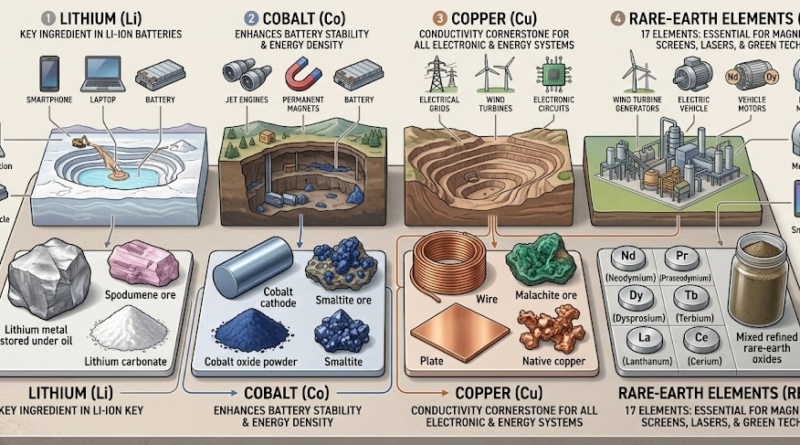
EDITORIAL ANALYSIS — Humankind is currently caught in a profound paradox: to build a low-carbon future, we must first engage in an unprecedented level of high-carbon extraction. Wind turbines, solar panels, and electric vehicle (EV) batteries are the backbone of the energy transition, but they are physically made of lithium, cobalt, copper, and rare-earth elements.
Mining, by its very nature, is an extractive and finite process. As we look toward 2050, the global community is grappling with how to reconcile the destruction of “pristine rainforests” with the salvation of the global climate.
Weak Sustainability: The “Capital Trade-Off”
The UN and the International Energy Agency (IEA) have introduced the concept of ‘Weak Sustainability’ to justify modern mining.
- The Theory: It argues that the loss of natural resources is acceptable if it is replaced by “Human Capital”—infrastructure, education, and technology that outlasts the mine itself.
- The Goal: Using the wealth generated from a lithium mine to build a carbon-free power grid and high-tech schools, theoretically leaving future generations “wealthier” despite the lost landscape.
Sustainable Mining: The Circular Dream
While minerals taken from the ground don’t grow back, the concept of ‘Sustainable Mining’ focuses on what happens after extraction.
- The Infinite Loop: Once minerals are in the system, they should be recycled indefinitely.
- The Gap: Currently, the recycling rate for critical minerals is a dismal 5%. Until this reaches near 100%, we remain trapped in a cycle of continuous digging.
Responsible Mining: Cleaning the Process
Since we cannot avoid mining today, the industry has adopted ‘Responsible Mining’ frameworks to minimize the immediate “footprint” of extraction:
- Green Fuel: Powering massive haul trucks with Green Hydrogen instead of diesel.
- Renewable Sites: Installing onsite solar and wind farms to run mining equipment.
- Social License: Seeking Free, Prior, and Informed Consent (FPIC) from local and indigenous communities and sharing profits directly with them.
We are essentially “borrowing” from the Earth’s crust to pay off our carbon debt. Mining can never truly be “sustainable” in the biological sense, but it can be responsible. The real victory will come when our recycling technology catches up to our extraction speed, turning every discarded battery into a “new” mine.