
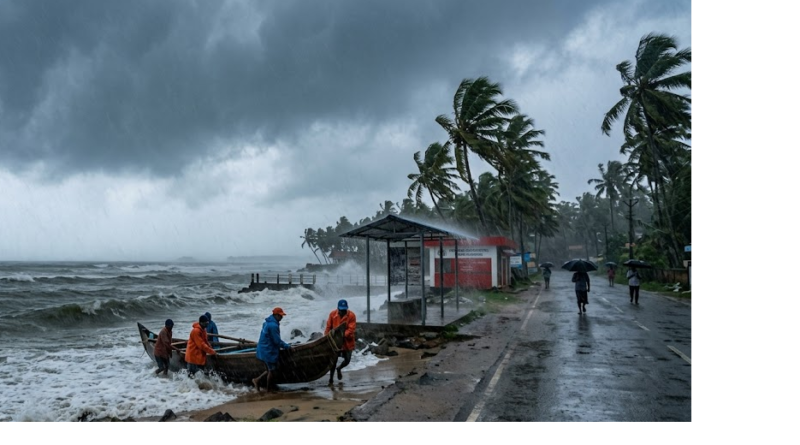
IMD Downgrades Monsoon Forecast to 90%
NEW DELHI: India’s agricultural heartland is bracing for a dry summer as the India Meteorological Department (IMD) on Friday officially lowered its forecast for the 2026 southwest monsoon. The agency now projects rainfall at just 90% of the Long Period Average (LPA), a concerning drop from the 92% predicted in April, while simultaneously confirming that the monsoon’s critical arrival over Kerala will be delayed.
The forecast cements the likelihood of a “below-normal” season, pushing India’s primary water source precariously close to deficit territory and raising the looming spectre of drought across the subcontinent.
A Rare Miss on Kerala Onset
The IMD conceded that the monsoon will not make landfall in Kerala within the four-day window of its original May 26 prediction. Instead, the arrival has been pushed to the first week of June. This marks a rare miscalculation for the weather agency; the last time the IMD erred in its Kerala onset prediction was in 2015.
“It happens sometimes,” IMD Director-General Mrutyunjay Mohapatra explained, defending the agency’s tracking. “But if you look at it, the monsoon system has been steadily advancing. It is hardly about 100 km away from the Kerala coast. I have said seven days, but it can cross anytime.”
D.S. Pai, head of the IMD’s Regional Meteorological Centre in Chennai and co-author of the department’s statistical forecasting model, offered a more nuanced meteorological picture. While the monsoon reached the Andaman Sea on schedule, the necessary atmospheric mechanics have stalled. “The only thing is, the wind has not strengthened,” Pai noted.
El Niño and the Spectre of Drought
The primary culprit behind the downgraded forecast is a looming El Niño, a climate pattern notorious for suppressing Indian monsoons. The IMD now estimates a staggering 92% probability of El Niño conditions dominating the season.
Consequently, the IMD has placed the probability of a “deficient” monsoon—defined as rainfall under 90% of the LPA—at a high 60%. While the meteorological agency strictly avoids the term “drought” in its official lexicon, leaving that designation to the Agriculture Ministry, the implications are stark.
Issuing two deficiency warnings before the monsoon has even reached the mainland is an alarming precedent not seen since 2015. The historical parallels are uncomfortable: 2015 also saw an overshot onset prediction (from May 30 to June 5) and a downgraded April forecast, ultimately ending with a severe 86% rainfall realization. Coupled with an 88% realization in 2014, it resulted in consecutive deficient years fueled by a building El Niño.
Regional Disparities and Agricultural Alarm
The geographical distribution of the expected rainfall paints a grim picture for India’s farmers. Of the four broad geographical regions, only the Northeast is projected to receive a “normal” monsoon. The Northwest, Central India, the Southern Peninsula, and the crucial monsoon core zone—which sustains the vast majority of the country’s rain-fed farmland—are all expected to face shortages. Rainfall for the month of June alone is projected to fall below 92% of its historical average.
Whether the 2026 season mirrors the devastation of 2015 now hinges on intra-seasonal wildcards. A positive Indian Ocean Dipole or a favorable Madden-Julian Oscillation could inject much-needed moisture into the system, but both phenomena are currently absent. Agricultural experts warn that the crisis goes beyond just the total volume of rain.
“The problem is not just the total reduction in rainfall, but the way the rainfall is distributed,” warned G.V. Ramanjaneyulu, Executive Director of the Centre for Sustainable Agriculture. “Crops can manage dry spells of about one week. Beyond that, the soils are unable to support them. Insufficient rainfall will prevent groundwater recharge. That may affect irrigated crops as well, including rice and others.” As the rain clouds stall 100 kilometers off the Malabar coast, the coming weeks will prove critical for India’s food security and rural economy.