
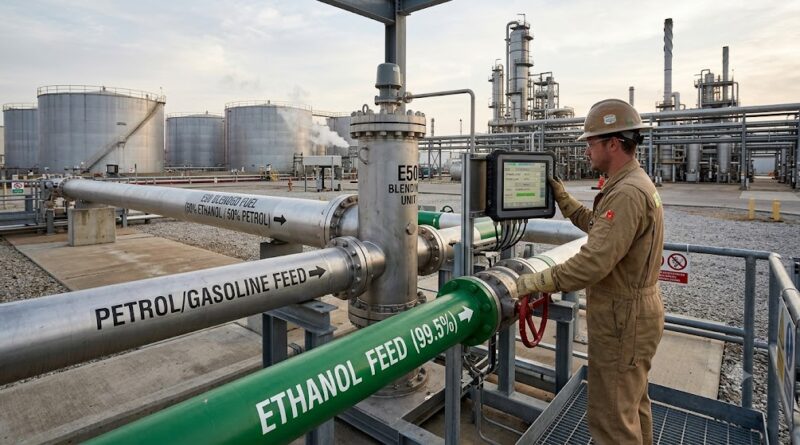
Clearing the Tax Roadblocks: Government Waives Excise Duty on Higher Ethanol Blends
Late-night policy drops from New Delhi usually signal big structural shifts, and Wednesday’s gazette notification is no exception. In a decisive move to supercharge India’s bio-fuel ambitions, the Union government completely scrapped the central excise duty on higher-quantum ethanol-blended petrol.
By exempting blends at 22%, 25%, 27%, and 30%, the government is effectively clearing the financial runway for a greener fuel ecosystem. But beneath the headline-grabbing tax cuts lies a brilliant bit of bureaucratic plumbing designed to solve a messy taxation paradox.
Escaping the “Double Taxation” Trap
To understand why this move is a big deal, you have to look at the quirky way fuel is taxed in India. Blending ethanol with petrol is legally classified as a “manufacturing activity.” Without this new exemption, the blending process was an invitation for the taxman to dip into the same pot twice.
The Centre broke down the math behind the madness:
- Stage 1: Raw petrol is slapped with heavy Central Excise Duty.
- Stage 2: Pure ethanol attracts GST.
- The Trap: When oil marketing companies blend the two together, the resulting mixture risked being hit with excise duty all over again on the entire combined volume.
Previously, the Ministry of Finance had only shielded blends up to 20% (E20) from this double levy. By extending the shield all the way up to 30%, the government has mathematically insured that clean energy won’t be choked by redundant taxation.
The New Fuel Tax Matrix at a Glance
| Ethanol Blend Quantum | Previous Excise Status | New Excise Status |
| Up to 20% (E20) | Exempted | Exempted |
| 22%, 25%, 27%, 30% | Subject to Dual Levy Risk | Fully Exempted |
| 85% (E85 Variant) | Launched June 5 | Strategically Supported |
Hold Your Horses: The Fine Print
Before you expect to see E30 nozzles at your local petrol pump tomorrow morning, the government has urged everyone to read the fine print. This gazette notification is about regulatory readiness, not immediate commercial rollout.
“This is a preliminary prerequisite for eventually introducing higher blends, but doesn’t convey anything about rollout of higher blends as of now as that will only be done after extensive testing and consultation.”
— Union Government Statement
Essentially, the state is setting the rules of the game before the players take the field. This comes just days after India formally launched the high-octane E85 variant (85% ethanol, 15% gasoline) on World Environment Day (June 5, 2026). The message is clear: the infrastructure is being laid out well in advance.
Industry Response: The Ball is Now in the States’ Court
Unsurprisingly, the ethanol manufacturing value chain is cheering. C.K. Jain, President of the Grain Ethanol Manufacturers Association (GEMA), hailed the decision as a “strong signal of policy stability and long-term commitment.” According to Jain, this tax clarity is exactly what Wall Street and domestic venture capitalists need to see before pouring fresh investments into production plants, logistics, storage, and flex-fuel mobility solutions.
However, the real test of this policy’s success moves from New Delhi to state capitals. Bharati Balaji, Deputy Director General at the All-India Distillers Association (AIDA), quickly pointed out the next major hurdle: State Taxes. For the full financial benefit of this excise waiver to actually reach your wallet at the fuel pump, individual state governments must now step up and align their local tax structures with the Centre’s green vision.
A Masterclass in Policy Foresight
For years, the Indian auto industry and green-energy advocates complained that policy flip-flops made long-term planning impossible. This move changes the narrative. By fixing the tax anomalies of E22 to E30 blends before the fuels are commercially rolled out, the government is removing the friction points that usually stall massive energy transitions.
The real challenge now shifts to Detroit-style engineering inside Indian auto plants. The tax path is clear, and the fuel is coming—but are Indian car engines ready to swallow a 30% ethanol mix without corroding? The regulatory ball is in the automakers’ and the states’ court now.