
Capitol Hill Strikes Back: Congress Rebukes Trump’s Iran Strategy
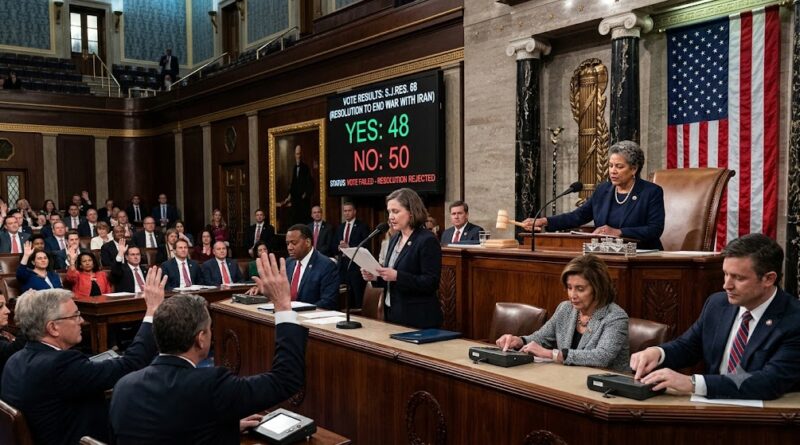
The political tightrope over the conflict with Iran just got even more precarious. In a tight 50-48 vote, the U.S. Senate has passed a concurrent resolution demanding that President Donald Trump withdraw American forces from active hostilities with Iran unless Congress explicitly grants military authorization.
While the White House is trying to nail down the delicate, leaked $300 billion framework agreement in Geneva, Capitol Hill has formally signaled its deep discomfort with executive war-making.
The Legal Anatomy: What is a “Concurrent Resolution”?
The timing of the vote sends a massive political shockwave, but its actual legal teeth are a matter of intense constitutional debate. Because Congress chose to pass a concurrent resolution rather than a joint resolution, the legislative mechanics function differently:
- No Presidential Desk: This measure does not go to President Trump for a signature or a veto. It bypasses the executive branch entirely.
- Disputed Legal Force: Historically, concurrent resolutions are used to express the “sense of Congress.” While it officially puts both chambers on record against the war that erupted in late February, the executive branch routinely argues these measures lack binding statutory power.
- The Veto Proofing: During his first term, Trump successfully vetoed War Powers bills regarding Yemen (2019) and Iran (2020) because Congress couldn’t muster the two-thirds majority to override them. By using a concurrent resolution now, Congress avoids a veto battle but leaves the legal enforcement in a constitutional gray area.
The 1973 War Powers Act vs. Executive Authority
At the heart of this clash is the War Powers Act of 1973, a post-Vietnam War statute designed to check presidential military overreach.
| Statute Requirement | Executive Stance | Congressional Stance |
| The 60-Day Clock | The White House argues that restricting the Commander-in-Chief’s power to wage or de-escalate an active conflict is unconstitutional. | Presidents must get formal congressional authorization within 60 days of introducing U.S. forces into hostilities. |
| Strategic Leverage | The administration views congressional interference as a disruption that weakens Trump’s leverage during the Geneva peace talks. | Congress asserts its constitutional right as the sole branch empowered to declare war, refusing to write a blank check for regional escalation. |
Negotiation in a Pressure Cooker
President Trump was quick to dismiss the vote on Truth Social, blasting it as “poorly timed and meaningless” and adding, “These Senators have just made my job more difficult, but I will get it done… because I always get it done!” Meaningless? Legally, perhaps. Strategically? Far from it.
Tehran is watching this play out in real-time. While Trump is trying to project absolute authority and issue ultimatums about resuming the war if Iran fails to downblend its uranium, Congress has effectively broadcast to the world that the American public has little appetite for an extended West Asian conflict. This resolution might not legally force Trump’s hand, but it certainly shrinks his political maneuvering room just as the Friday signing deadline in Geneva approaches.