
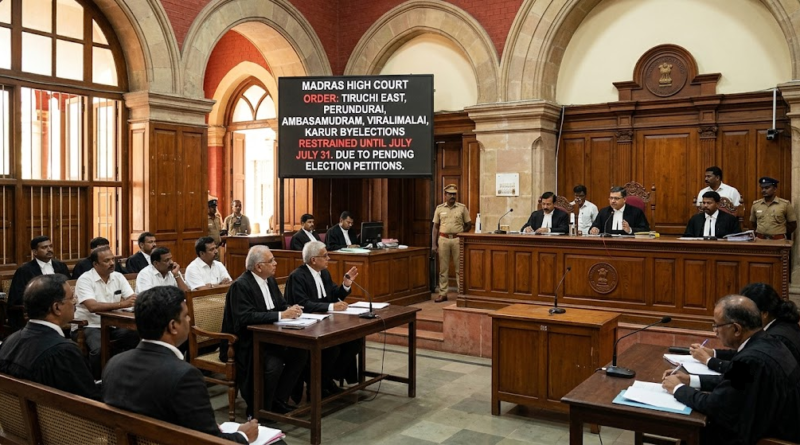
Madras High Court Halts Byelections in 5 Tamil Nadu Constituencies
The Madras High Court has issued an interim order restraining the Election Commission of India (ECI) from issuing byelection notifications for five Tamil Nadu Assembly constituencies until July 31.
The order, passed by a Division Bench comprising Chief Justice Sushrut Arvind Dharmadhikari and Justice G. Arul Murugan, comes in response to a Public Interest Litigation (PIL) petition challenging the notification of byelections while election petitions against the original results remain pending.
Key Details at a Glance
| Parameter | Details |
| Constituencies Involved | Tiruchi East, Perundurai, Ambasamudram, Viralimalai, and Karur |
| PIL Petitioner | K. Venkatachalapathy (Tirunelveli) |
| Core Conflict | Resigned legislators vs. Pending Election Petitions (EPs) challenging their original wins |
| Key Risk Cited | Potential for two individuals claiming representation if an EP is allowed after a byelection |
| Next Hearing / Deadline | July 31 (Deadline for respondents to file counter-affidavits) |
Breakdown of Arguments
1. The Petitioner’s Stand
- Not a “Clear Vacancy”: The petitioner argued that under Section 151A of the Representation of the People Act, 1951, a vacancy created by resignation cannot be deemed a “clear vacancy” if the original election is actively being challenged in court.
- Consequential Relief Sought: All five election petitioners (losing candidates from the recent elections) did not merely challenge the victories—they also petitioned the court to declare them as the rightful winners.
- Supreme Court Precedents: Counsel cited three key apex court rulings holding that byelections should not proceed while election petitions for those seats are pending:
- Sanjeevayya v. Election Commission of India (1967)
- Election Commission of India v. Telangana Rashtra Samithi (2011)
- Pramod Laxman Gudadhe v. Election Commission of India (2018)
2. The Respondents’ Defense
- Timeline Distinction (Advocate-General): Advocate-General Vijay Narayan argued there is a legal distinction between legislators who resigned before an election petition was filed versus those who resigned after.
- Example: Chief Minister C. Joseph Vijay resigned from Tiruchi East on May 10, whereas his rival (S. Inigo Irudayaraj) filed the election petition substantially later.
- Locus Standi & Prematurity (CM’s Counsel): Senior Counsel G. Masilamani questioned the PIL petitioner’s standing (locus standi) to instruct the ECI and noted the petition was premature since the ECI had not yet formally notified any byelections.
The Court’s Ruling & Observation
“In matters touching upon the purity of the democratic process, a narrow and pedantic interpretation of locus standi cannot be applied.”
— Madras High Court Division Bench
- Rejected Strict Locus Standi: The Bench dismissed arguments regarding the petitioner’s standing, emphasizing the broader public interest in democratic integrity.
- Accepted Need for Deeper Scrutiny: The judges acknowledged the Advocate-General’s point regarding the sequence of dates (resignation date vs. EP filing date) as a nuanced legal issue requiring comprehensive review before a final order is issued.