
‘Smart Borders’ as Solution For Border Infiltration
Table of Contents
In a major policy declaration that signals a decidedly aggressive shift in India’s internal security doctrine, Union Home Minister Amit Shah laid out a formidable two-pronged strategy on Friday: an absolute halt to border infiltration with ‘Smart Borders’ and the systematic expulsion of existing infiltrators.
Speaking with the clarity and firmness we have come to expect from the Home Ministry on matters of national security, Shah made it clear that the government is no longer just playing defense at the borders. The focus is shifting toward active domestic enforcement to prevent what he termed “unnatural demographic changes” within the country.
Here is the breakdown of the Home Minister’s latest security roadmap and what it means for India’s border management.
The Demographic Defense
For years, the political and security discourse around illegal immigration has been a flashpoint. Friday’s statement crystalizes the government’s stance into actionable policy. By explicitly linking infiltration to “unnatural demographic changes,” Shah is framing border security not just as a matter of territorial integrity, but as a defense of India’s socio-cultural and demographic fabric.
The mandate is clear: the apparatus of the state will be mobilized not only to lock the front door but to identify and expel those who have already bypassed it.
The “Smart Borders” Promise
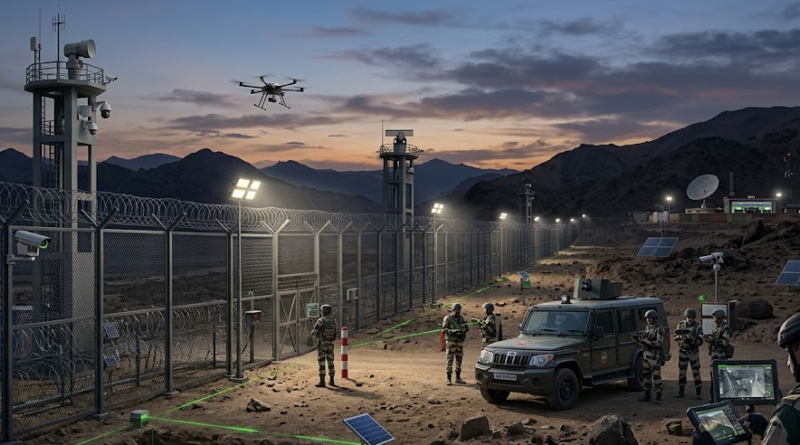
How does the government plan to achieve the target? The answer lies in a highly anticipated technological overhaul of our frontier defenses and make the ‘Smart Borders’.
Shah teased the upcoming unveiling of a comprehensive “Smart Border” concept. Anyone who has reported on or served along the Radcliffe Line knows that physically guarding every inch of the Pakistan and Bangladesh borders—with their treacherous terrains, shifting riverine patches, and dense forests—is a logistical nightmare.
The Smart Border initiative aims to render these frontiers completely “impregnable.” While the exact technological blueprint remains under wraps, veteran security analysts expect this to heavily feature:
- Advanced Surveillance: Drones, thermal imaging, and underground sensors to detect movement in blind spots.
- Integrated Command Centers: Real-time data sharing between border outposts and central command.
- Plugging the Gaps: Replacing physical fencing in difficult terrains with “laser walls” and electronic surveillance grids.
We are looking at a paradigm shift. Moving from physical patrols to a tech-driven “Smart Border” brings India’s frontier management into the 21st century. However, the true test of this policy will lie in its domestic execution.
Pledging to expel “each infiltrator” is a monumental bureaucratic and legal undertaking. It will require watertight identification processes, massive coordination between central agencies and state police, and complex diplomatic navigation with neighboring countries regarding deportations.
The blueprint has been drawn. Now, all eyes will be on the rollout of the Smart Border tech and the subsequent on-the-ground operations. One thing is certain: the frontier is getting a massive upgrade, and the tolerance for illegal crossings has officially dropped to zero.