
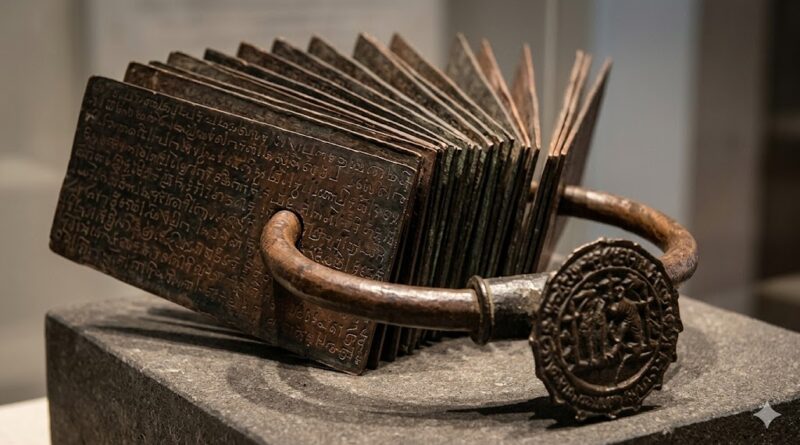
Netherlands Returns Chola-Era ‘Leiden’ Copper Plates to India
The Hague: In what historians and archaeologists are calling a watershed moment for cultural repatriation, the Government of the Netherlands has officially returned the invaluable Chola-era Anaimangalam copper plate charters to India. The 1,000-year-old artifact stack, held by Leiden University for nearly two centuries, was formally handed over at a ceremony in The Hague on Saturday in the presence of Prime Minister Narendra Modi and Dutch Prime Minister Rob Jetten.
The return marks the first time a Chola-period copper plate charter has been repatriated to India, sparking fresh calls by historians to reclaim other exiled artifacts, including the famous Pandya-era Velvikkudi copper plates currently housed in the British Museum.
Key Highlights
- The Artifact: A complete set of 21 large plates (5 Sanskrit, 16 Tamil) and 3 small Tamil plates, strung on a ring bearing the royal Chola insignia.
- Historical Significance: Tells the historic saga of two legendary Chola emperors—Raja Raja Chola I and Rajendra Chola I—and their inter-faith patronization of Buddhism.
- The Handover: Facilitated at a diplomatic summit in the Netherlands during PM Modi’s ongoing European tour.
The Anaimangalam Charter: A Symbol of Inter-Faith Harmony
Popularly known in academic circles as the Leiden copper plates, the inscriptions serve as an enduring record of maritime history, trade, and cultural diplomacy during the peak of the Chola Empire.
The larger plates record an oral commitment made by Emperor Raja Raja Chola I (985–1014 CE) to gift land from the village of Anaimangalam (near Nagapattinam) to construct a Buddhist Vihara. The monastery, named the Chulamanivarma Vihara (or Raja Raja Cholan Perumpalli), was built by King Sri Mara Vijayotunga Varman of the maritime kingdom of Java (modern-day Indonesia) in honor of his father.
Cross-Generational Implementation
While Raja Raja Chola I sanctioned the land grant, it was his illustrious son, Rajendra Chola I (1014–1044 CE), who formally codified the order into the 21 large copper plates.
Decades later, the smaller plates document how two emissaries from the Javanese kingdom traveled to the court of Kulottunga Chola I (1070–1120 CE) to ensure the continuity of the grants. Kulottunga Chola I reaffirmed the edict, augmenting the original grant of 8,943 kalam (a historical unit of measurement) of paddy with an additional 4,500 kalam and extra lands for the Buddhist sangha.
A Lost Monument: While the copper charters have survived, the physical tower of the Chulamanivarma Vihara in Tamil Nadu was tragically demolished by Jesuit priests in 1867 with the explicit authorization of the British colonial government of Madras.
Anatomy of the Chola Royal Insignia
The 24 plates are held together by a massive bronze ring featuring the highly detailed royal seal of the Chola dynasty. The seal serves as a political map of medieval South India’s power balance, featuring:
- The Chola Tiger: The central royal emblem of the dynasty.
- The Twin Fish & Chera Bow: Representing the Pandyas and Cheras, strategically placed underneath or beside the tiger to signify that the Cholas had successfully subjugated their regional rivals.
- Imperial Regalia: Curated with dual chamaras (fly-whisks), the royal parasol, ceremonial lamps, and a swastika.
The seal of the larger plates explicitly features the village name “Anaimangalam” engraved in Tamil script alongside a short Sanskrit sloka praising Rajendra Chola I, while the smaller ring contains a verse honoring Kulottunga Chola I.