
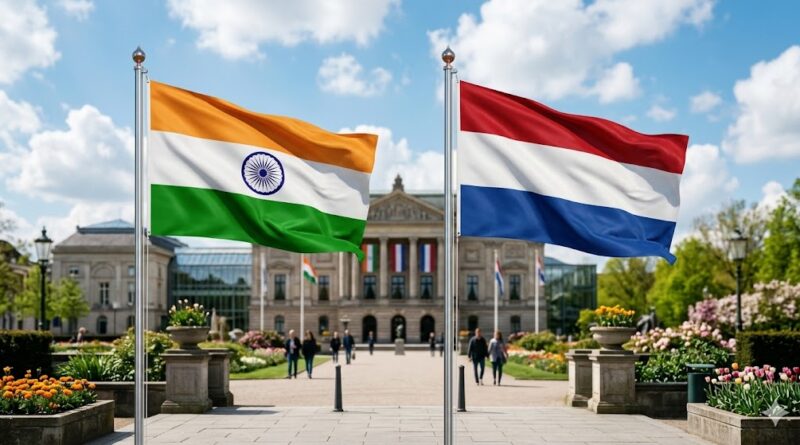
India-Netherlands Elevate Ties to Strategic Partnership
Amsterdam: India and the Netherlands have officially upgraded their bilateral relationship to a Strategic Partnership during Prime Minister Narendra Modi’s two-day visit over the weekend. While the visit yielded 17 major economic and technology agreements, it also witnessed diplomatic friction over human rights, press freedoms, and a long-standing cross-border child custody dispute.
Following the meetings, PM Modi flew to Sweden on Sunday before heading to Oslo on Monday to continue his five-nation European tour.
Key Highlights
- The Upgrade: Bilateral ties elevated to a formal Strategic Partnership.
- Major Accords: 17 agreements signed across semiconductors, water, agriculture, health, and critical minerals.
- Semiconductor Breakthrough: A new fabrication project established between TATA Electronics and Dutch tech giant ASML.
- Diplomatic Friction: Dutch PM Rob Jetten publicly noted raising concerns over Indian minority rights and press freedoms; New Delhi strongly pushed back, terming the criticism a “lack of understanding.”
- Consular Dispute: The high-profile Insiya international abduction case was formally raised by the Dutch leadership.
TATA-ASML Semiconductor Deal Tops 17 Accords
Prime Minister Modi stated that the high-level meetings injected a “new momentum” into the bilateral dynamic. Taking to social media, he noted:
“From elevating our relationship to a Strategic Partnership to expanding cooperation in water resources, semiconductors, innovation, defence, sustainability and mobility, we have charted an ambitious road map for the future.”
The cornerstone of the 17 signed MoUs is a high-tech partnership between TATA Electronics and the world’s leading semiconductor equipment maker, ASML, to cooperate on a semiconductor fabrication project. Other key agreements targeted the “WAH” sectors (Water, Agriculture, and Health), along with renewable energy supply chains and critical mineral exploration.
Clash Over Press Freedom and Minority Rights
Despite the economic successes, recently elected Dutch Prime Minister Rob Jetten used the diplomatic platform to address domestic and European anxieties regarding India’s internal politics. Speaking at his official residence, the Catshuis, Jetten remarked:
“The strategic partnership we are entering into today between India and the Netherlands also offers us opportunities to discuss sensitive topics more frequently… The Netherlands and the European Union are worried about press freedom and minority rights, among them the Muslim community and smaller communities.”
India’s Sharp Pushback
The External Affairs Ministry issued a direct counter-response during a press briefing on Sunday. Ministry Secretary (West) Sibi George strongly dismissed the assertions when questioned by Dutch journalists:
- On Indian Pluralism: “This question comes because of the lack of understanding… Today we are 1.4 billion people, diverse, living in peace and harmony. And a democratically elected government where peaceful transition of power happens.”
- Direct Advice to European Media: “You need to have more understanding of India to appreciate what India is,” George told a reporter from the Dutch newspaper NRC.
Furthermore, an MEA spokesperson clarified to the press that PM Jetten did not actually raise these specific political or human rights issues during the formal, closed-door bilateral meetings, despite his public statements to the European media.