
Mission Drishti: India’s Private Space Sector Hits New Heights with World-First ‘OptoSAR’ Launch
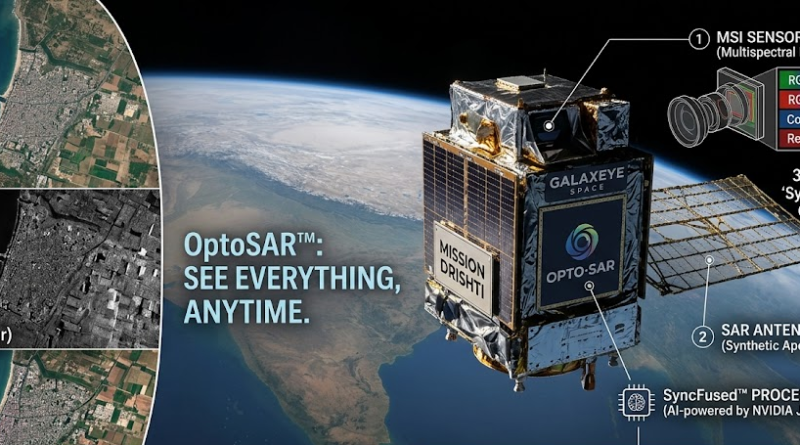
VANDENBERG, CALIFORNIA — India’s private space sector just took a giant leap from “emerging” to “world-leading.” On Sunday, May 3, 2026, the Bengaluru-based start-up GalaxEye successfully launched Mission Drishti—the world’s first multi-sensor earth observation satellite of its kind—into orbit.
Lifted by a SpaceX Falcon 9 rocket, the 190-kilogram satellite is now the largest privately developed earth observation platform in India’s history.
The “OptoSAR” Innovation: Seeing Through the Clouds
Conventional satellites usually carry either a camera (Electro-Optical/EO) or a radar (Synthetic Aperture Radar/SAR). GalaxEye’s “Drishti” is the first globally to fuse both into a single platform.
- EO (The Eyes): High-resolution imagery similar to traditional photography.
- SAR (The X-Ray): Uses radar pulses to “see” through thick cloud cover, smoke, and total darkness.
- The Hybrid Advantage: By combining both, Mission Drishti provides a “continuous” data stream. Whether it is a monsoon-covered forest in Kerala or a midnight operation in the Himalayas, the satellite remains effective 24/7.
Breaking Records: The Heavyweight of Private Tech
At 190 kg, Mission Drishti marks a significant scale-up for Indian space start-ups.
- Previous Era: Most private Indian satellites were “CubeSats” or “Nano-satellites” weighing under 50 kg.
- The New Era: Drishti’s size allows it to carry more sophisticated sensors and power systems, moving India closer to competing with global giants like Maxar or Planet.
Strategic Impact: From Agriculture to Defense
The “All-Weather” capability of the OptoSAR platform has massive implications for several sectors:
- Disaster Management: Real-time mapping of floods or cyclones, even when cloud cover renders standard satellites blind.
- National Security: Uninterrupted monitoring of border regions regardless of weather conditions.
- Agriculture: High-precision data for crop monitoring and yield estimation during the monsoon season.
In the space race, we often focus on the rockets, but the real power lies in the “Eyes” in the sky. By solving the “cloud-cover” problem with OptoSAR, GalaxEye hasn’t just launched a satellite; they’ve launched a global solution. For a country like India, where the monsoon often acts as a curtain for traditional satellites, Mission Drishti is exactly the vision we need.