
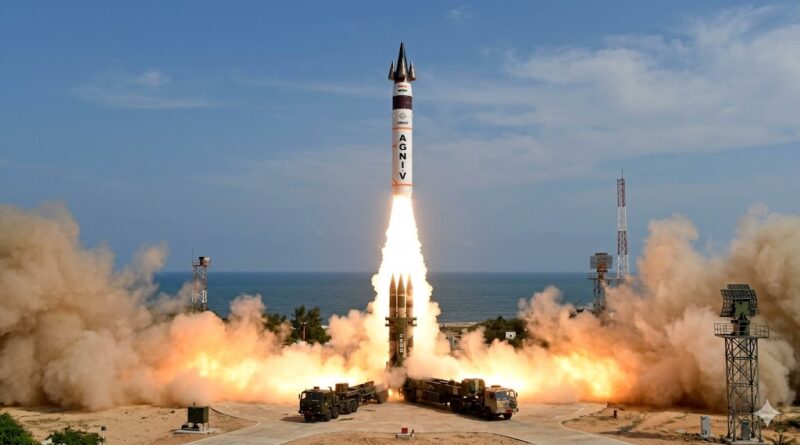
Mission Divyastra: The Agni-V MIRV Milestone
India has successfully validated its Multiple Independently Targetable Re-entry Vehicle (MIRV) technology. This test, conducted on Friday, May 8, 2026, from Dr. A.P.J. Abdul Kalam Island, is a “force multiplier” in every sense of the word.
- The “Multiple” Factor: Unlike traditional missiles that carry a single warhead to a single target, the MIRV-equipped Agni-V can carry multiple payloads.
- Spatial Distribution: During the test, payloads were successfully deployed to separate targets “spatially distributed” across the Indian Ocean Region.
- Elite Club: This capability places India in a very exclusive league of nations, including the US, Russia, China, France, and the UK, who possess the technology to saturate enemy missile defenses using a single launch vehicle.
Strategic Note: The “Divyastra” (Divine Weapon) mission is significant because it enhances India’s “No First Use” policy by ensuring a credible, multi-targeted second-strike capability that is much harder for an adversary to intercept.
What exactly is an MIRV?
In the old days of missile technology, one missile meant one warhead and one target. Think of it like a single-passenger taxi. If the enemy had a decent Ballistic Missile Defence (BMD) system, they could intercept that “taxi” and the threat was gone.
MIRV (Multiple Independently Targetable Re-entry Vehicle) changes the rules of the game completely. It’s no longer a taxi; it’s a high-speed luxury bus.
Once the Agni-V reaches the edge of space, the “bus” opens up. Instead of one warhead, it releases several. But here’s the kicker: each warhead can be programmed to hit a completely different target hundreds of kilometers apart.
- Saturating Defenses: How do you stop five or ten warheads screaming down at Mach 24 simultaneously? Most missile shields would simply “choke” under the sheer volume.
- Precision: The Ministry confirmed these payloads were “spatially distributed.” In layman’s terms: we can now strike multiple command centers or industrial hubs across a massive geographical area with a single launch.
The Strategic “Why”: Deterrence 2.0
India’s nuclear doctrine is built on “No First Use” (NFU). This means we must be able to survive a first strike and then retaliate so devastatingly that the adversary regrets the thought of ever attacking.
- The Northern Challenge: Let’s be blunt—this is about our northern neighbor. As China improves its missile defense shields, a single-warhead Agni might have been seen as “interceptable.” With MIRV, that certainty for the adversary vanishes.
- Survival of the Fittest: By putting multiple warheads on one missile, India can maintain a smaller, more lethal, and more “survivable” arsenal. You don’t need 100 missiles if 20 of them can do the job of 100.
- Global Standing: Before Friday, only the US, Russia, China, France, and the UK had mastered this. India has now effectively ended that monopoly.
A New Era of Leadership
It’s no coincidence that this technological leap happened just as Lt.-Gen. N.S. Raja Subramani and Vice-Admiral Krishna Swaminathan were named to lead our forces. We are seeing a shift from “traditional” warfare mindsets to a “tech-first” strategic posture.
Subramani, with his deep NSC background, understands the “Jointness” required to manage such strategic assets. Swaminathan, a Ph.D. in International Studies and an Electronic Warfare specialist, knows that in the 2020s, the battle is won in the electromagnetic and digital domains long before the first shot is fired.
Mission Divyastra isn’t just a flight test; it’s a diplomatic statement. It tells the world that India’s “No First Use” policy is backed by a “Second Strike” that is now virtually impossible to stop. The Agni-V MIRV hasn’t just crossed a distance of 5,000+ kilometers; it has crossed a massive threshold in global power dynamics.