
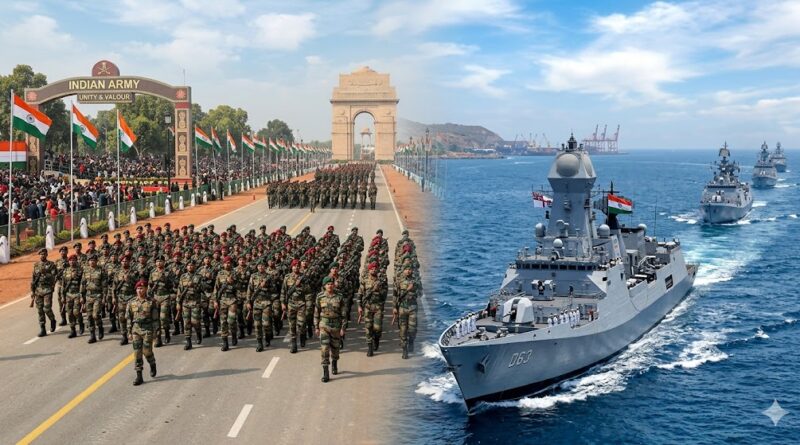
Chief of Defence Staff and Chief of the Naval Staff Appointments
On 9 May 2026 the Union government announced Lieutenant-General N.S. Raja Subramani (retd) as the next Chief of Defence Staff (CDS). Government has also appointed Vice-Admiral Krishna Swaminathan as the next Chief of the Naval Staff.
Both the Chief of Defence Staff (CDS) and the Chief of the Naval Staff (CNS) slated to change over in late May 2026. Tthese appointments mark a major step in the ongoing evolution of India’s integrated military structure.
Leadership Transition Overview
| Feature | Chief of Defence Staff (CDS) | Chief of the Naval Staff (CNS) |
| Appointee | Lt.-Gen. N.S. Raja Subramani (retd) | Vice-Admiral Krishna Swaminathan |
| Succeeds | General Anil Chauhan | Admiral Dinesh Kumar Tripathi |
| Effective Date | May 30, 2026 | May 31, 2026 |
| Commissioned | Dec 1985 (8 Garhwal Rifles) | 1987 (Indian Navy) |
| Current Role | Military Adviser, NSC Secretariat | FOC-in-C, Western Naval Command |
Lt.-Gen. N.S. Raja Subramani (retd): The Strategic Architect
Lieutenant-General Subramani’s appointment as the third CDS brings a wealth of joint-services experience and strategic depth.
- Diverse Operational Command: He has led troops in some of India’s most sensitive regions, including Assam (Operation Rhino), Jammu & Kashmir, and the Western Front (as Commander of the elite 2 Corps).
- Scholarly Approach: Beyond his tactical prowess, he is highly educated, holding degrees from King’s College London and the National Defence College. This academic background likely served him well during his recent stint at the National Security Council Secretariat.
- Key Mandate: As CDS and Secretary of the Department of Military Affairs (DMA), his primary focus will be furthering “jointness”—integrating the Army, Navy, and Air Force into a cohesive fighting force.
Vice-Admiral Krishna Swaminathan: The Tech-Savvy Mariner
Vice-Admiral Swaminathan’s rise to the top of the Navy signals a focus on modern warfare and technological edge.
- Specialization: He is a specialist in Communication and Electronic Warfare, critical fields as the Indian Navy expands its surveillance and digital capabilities in the Indian Ocean Region.
- Frontline Leadership: He has commanded the “Sword Arm” of the Navy (Western Fleet) and major capital ships, including the guided-missile destroyer INS Mysore and the aircraft carrier INS Vikramaditya.
- Academic Depth: He notably holds a Ph.D. in International Studies, suggesting a sophisticated understanding of the geopolitical nuances involved in maritime diplomacy and regional security.
Awards & Honors
Both officers are highly decorated, reflecting decades of “distinguished service of the most exceptional order.”
- Lt.-Gen. Subramani: PVSM, AVSM, SM, VSM.
- Vice-Admiral Swaminathan: PVSM, AVSM, VSM.
The transition ensures that the top brass remains a mix of seasoned “boots-on-the-ground” experience and high-level strategic/academic insight.
With the security landscape in the Indo-Pacific becoming increasingly complex, these appointments suggest the government is leaning into leaders who balance traditional command experience with a deep understanding of international relations.