
Iran Formalizes Hormuz Tolls as Global Trade’s Achilles’ Heel is Exposed
On Saturday, Ebrahim Azizi, Head of the Iranian Parliament’s National Security Committee, announced the launch of a new “professional mechanism” to manage maritime traffic through the Strait of Hormuz. This move comes just days after Tehran established a dedicated regulatory body, the Persian Gulf Strait Authority (PGSA).
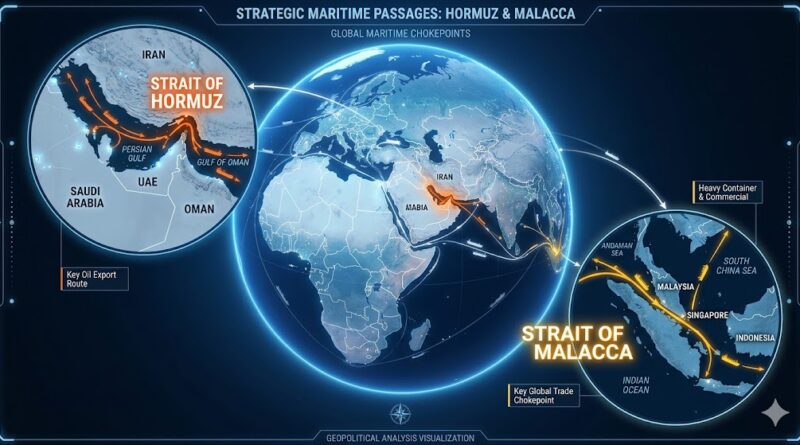
Iran has effectively formalized a sovereign toll and permission system for the vessels transiting a strait that handles one-fifth of the world’s oil and liquefied natural gas (LNG) supplies.
As the world continues to grapple with the energy crisis driven by this strategic stranglehold, the PGSA announcement lays bare a stark reality—the sheer fragility of the critical chokepoints connecting our global maritime routes.
The “Closed Ocean” Problem
While Hormuz is currently taking center stage, it is far from the only vulnerability. The Indian Ocean is the beating heart of global commerce. Each year, it sees roughly 100,000 ships transit its waters, accounting for 30% of global container traffic and 80% of the world’s sea-borne oil trade.
But as C. Raja Mohan, a visiting professor at the National University of Singapore’s Institute of South Asian Studies, points out, the Indian Ocean has a fundamental geographic flaw:
“Unlike the Atlantic and Pacific oceans, the Indian Ocean is closed; that is, a few straits control its access. This makes these straits immensely important for international trade.”
While Hormuz dictates access to the Persian Gulf, the broader ocean relies entirely on two primary gateways: the Strait of Malacca in the east and Bab-el-Mandeb in the west. Both are currently facing unprecedented pressures.
The Western Gate: Bab-el-Mandeb Under Threat
Literally translating to the ‘Gate of Tears’ due to its historical navigational dangers, Bab-el-Mandeb links the Red Sea to the Gulf of Aden. At its narrowest, it is a mere 26 kilometers wide.
Despite its size, nearly 9.3% of global crude oil and 8.7% of all sea-borne trade transited this route in 2023. However, it has been a severe flashpoint in recent years:
- Militant Disruptions: Following the outbreak of the Gaza conflict in 2023, Iran-backed Houthi militants heavily disrupted traffic. While attacks subsided by late 2025, traffic volumes have only marginally recovered in 2026.
- Fresh Threats: Just last month, Houthi Deputy Foreign Minister Hussein al-Ezzi openly threatened to block the strait entirely if the U.S. did not cease hostilities in Iran.
- The Cost of Avoidance: The only viable alternative for ships is routing around the Cape of Good Hope (Africa). This detour adds 10 to 14 days to the journey and saddles shipping companies with roughly $2 million in extra costs per trip.
The Eastern Bottleneck: The Malacca Dilemma
On the other side of the Indian Ocean lies the Strait of Malacca, a 900-kilometer stretch between Indonesia, Malaysia, and Singapore that narrows to just 2.8 kilometers.
It is the lifeblood of East Asia. A staggering 24% of global maritime trade, 45% of global oil shipments, and 26% of internationally traded cars squeeze through this passage. China alone relies on Malacca for 75% of its oil needs—a strategic vulnerability former Chinese President Hu Jintao famously dubbed the “Malacca Dilemma.”
While historically peaceful, the sheer volume of trade makes any policy shift here a global event. In April 2026, Indonesia’s Finance Minister briefly floated the idea of imposing a levy on ships passing through the strait. Though the Foreign Minister quickly backtracked to reinforce Indonesia’s commitment to freedom of navigation, the mere suggestion sent ripples through global markets.
Like Bab-el-Mandeb, bypassing Malacca via the Lombok or Sunda Straits adds up to five extra days at sea and bypasses the massive refueling and transshipment hubs in Singapore.
China’s ‘Malacca Dilemma’
The Strait of Malacca connects the Indian Ocean to the South China Sea, serving as the shortest maritime route between the Middle East, Africa, and East Asia. China’s vulnerability stems from several factors:
- Extreme Energy Dependency: China is the world’s largest importer of crude oil. Nearly 80% of China’s maritime oil imports pass through the Strait of Malacca. A disruption here would instantly paralyze the Chinese economy and its military apparatus.
- The Chokepoint Geometry: At its narrowest point (the Phillips Channel in the Singapore Strait), the waterway is only about 1.7 miles wide. This makes it incredibly easy to monitor, mine, or blockade.
- U.S. and Allied Naval Dominance: Beijing fears that in a contingency scenario—such as a military conflict over Taiwan or the South China Sea—the United States Navy and its allies could impose a naval blockade at Malacca. This threat has been amplified by expanding security networks, such as the U.S.-Indonesia Major Defense Cooperation Partnership, which continuously enhances Western maritime surveillance across the strait.
- The Indian Factor: India sits right at the western gateway of the strait via its Andaman and Nicobar Islands. India’s expanding military footprint and air-naval assets on these islands give New Delhi the capability to easily enforce “sea denial” and choke Chinese-bound traffic during a Himalayan or regional crisis.
How Beijing Is Trying to Solve It
Overland Corridors and Pipelines
China’s primary strategy has been to build “land bridges” that bypass the Malacca Strait entirely, moving energy and goods directly to Chinese territory from the Indian Ocean or Eurasia. The China-Myanmar Economic Corridor (CMEC) is one of Beijing’s most active workarounds. China built deep-water ports at Kyaukpyu on the Bay of Bengal, connected to Yunnan province via a 480-mile pipeline network. The China-Pakistan Economic Corridor (CPEC) link Gwadar Port on the Arabian Sea to China’s western Xinjiang region via a 2,000-mile network of highways, railways, and pipelines.
Alternative Maritime Routes
When land routes are insufficient, China seeks maritime detours. China is partnering with Russia to utilize Arctic shipping lanes made increasingly navigable by receding polar ice. Passing north of Siberia, this route cuts transit times to Europe and bypasses Malacca entirely. However, it remains a seasonal alternative plagued by extreme weather and a lack of deep-water infrastructure.
Naval Modernization (“String of Pearls”)
If China cannot fully bypass the Malacca Strait, it aims to defend it through sheer military power. The People’s Liberation Army Navy (PLAN) has undergone the fastest naval buildup in modern history, adopting a “Far Seas Protection” doctrine. China now possesses more battle force ships than the U.S. Navy and fields advanced aircraft carriers and destroyers meant to project power deep into the Indian Ocean.
Domestic Energy Transition
The ultimate solution to an energy chokepoint is to stop relying on imported fossil fuels. China has launched an aggressive domestic decoupling strategy. Leading the world in the adoption of Electric Vehicles (EVs) to drastically curb oil consumption. Massive buildouts of domestic renewable energy (solar and wind) and advanced nuclear power plants to guarantee grid independence.