
India’s Power System Strained as Peak Demand Hits Record 271 GW
NEW DELHI — India’s electricity grid crossed an unprecedented threshold this week as peak power demand shattered all historical records, soaring to nearly 271 GW on Thursday. While the Ministry of Power has hailed the achievement as a testament to the robust capacity of the national power network, a starkly different reality is playing out on the ground.
Despite official assurances, widespread power cuts, prolonged outages, and severe voltage fluctuations continue to plague major metros and rural hubs alike. The crisis has forced the government into a delicate balancing act—praising its own preparedness while simultaneously issuing public appeals urging citizens to use electricity judiciously.
The Data Gap: Unreported Deficits and Suppressed Demand
On Friday, Grid-India reported a peak power deficit of approximately 1.7 GW—a shortage that directly translates into rolling blackouts and load shedding. However, independent energy analysts warn that this official figure represents only the tip of the iceberg.
Energy governance experts point out that modern Supervisory Control and Data Acquisition (SCADA) systems monitor and reroute electricity primarily at the macro level to maintain overall grid stability. Localized outages managed independently by state distribution companies (discoms) operate in separate silos. By deliberately disconnecting neighborhoods to prevent sub-station overloads, discoms create “suppressed demand” that is never captured in national tracking metrics.
Conversely, some analysts argue that the gap is driven less by deliberate data suppression and more by unprecedented climate stress. Recent Grid-India data showed a 4% error margin in day-ahead forecasting and a 1% deviation in real-time forecasting, signaling just how drastically intense summer heatwaves are warping traditional demand models.
Generation vs. Distribution: The Infrastructure Bottleneck
On paper, India possesses sufficient generation capacity. The country’s total peak demand sits roughly neck-and-neck with the installed capacity of its stable thermal and hydroelectric plants—a ratio highly comparable to that of the United States. Yet, while power failures in the U.S. are rare, they have become a daily feature of Indian summer life.
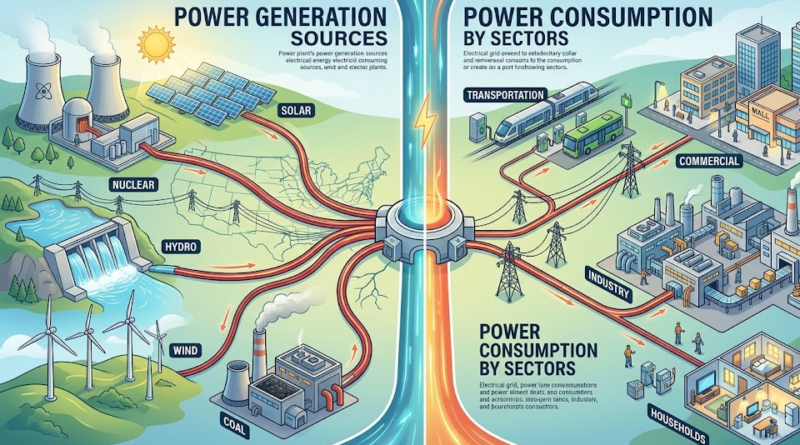
The Power Generation Mix
Currently, India relies heavily on traditional baseload power to sustain its grid, though clean energy continues to expand:
- Thermal Power: 72%
- Renewable Energy: 17%
- Hydroelectric: 9%
- Nuclear: 2%
Power engineers point the finger squarely at a failing distribution infrastructure that has starved of capital while demand skyrocketed. Critics argue that the privatization of highly profitable urban distribution segments has left state-owned discoms financially crippled. Because a massive share of the rural and low-income domestic consumer base cannot afford higher tariffs, these public discoms lack the liquidity required to upgrade aging transformers, cables, and substations.
Furthermore, even though India operates as a single synchronized national grid on paper, critical transmission bottlenecks frequently prevent power from flowing seamlessly from surplus regions to deficit zones.
The Renewable Energy Debate
The crisis has also reignited a fierce debate over how India integrates its rapidly growing renewable energy portfolio.
Some grid commentators argue that fluctuating renewables introduce dangerous volatility, noting that a sudden cloud cover can instantly knock a massive chunk of solar power off the grid, shifting an unsustainable stabilization burden onto traditional plants. They point to countries like Germany to argue that India must aggressively deploy advanced forecasting technologies to smoothly integrate green energy.
However, top energy scientists counter that blaming solar volatility for the current crop of blackouts is a misdiagnosis. Data shows that the most severe supply crunches and subsequent power cuts are occurring late in the evening—long after solar generation has wound down for the day—proving that India’s current battle is fundamentally one of baseload capacity, evening transmission, and local distribution failure.