
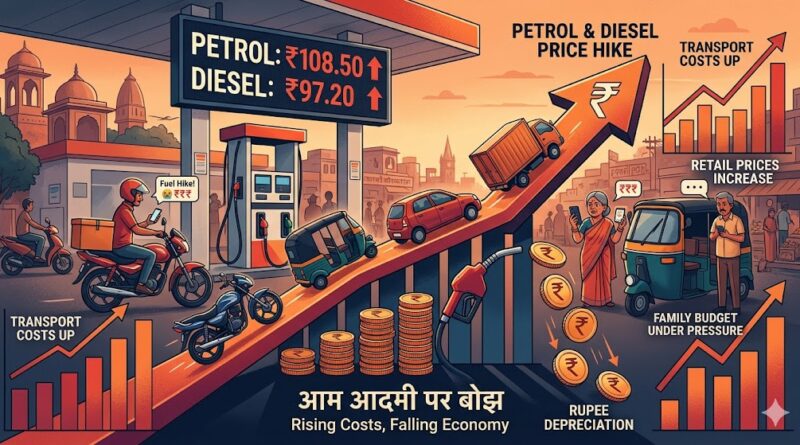
Fuel Shock: Petrol, Diesel Hiked Again as Global Crude Headwinds Batter OMCs
New Delhi: If you filled up your tank this morning, your wallet likely felt a bit lighter. For the second time in less than a week, government-owned oil marketing companies (OMCs) have aggressively raised fuel prices across India. On Tuesday, petrol and diesel prices jumped by roughly 90 paise per litre across all variants nationwide.
This latest hit comes hot on the heels of Friday’s massive ₹3 per litre hike—the first major price increase the country has seen in four years. In just five days, consumers are suddenly paying nearly ₹4 more per litre.
Here is a breakdown of the new retail prices in the capital and what is driving this sudden surge.
The New Reality at the Pump (Delhi)
- Petrol: Up 87 paise ➔ ₹98.64 / litre
- Diesel: Up 91 paise ➔ ₹91.58 / litre
Why is this happening now?
The simple answer: West Asia tensions and skyrocketing global crude oil prices.
India imports the vast majority of its oil, and the global benchmark, Brent crude, is currently stubbornly trading above the $100-per-barrel mark, even touching $110.90 on Tuesday evening. Compounding the issue is a weakening Indian Rupee, which makes importing that oil even more expensive.
According to industry experts, the OMCs have been eating massive losses for a long time to keep retail prices stable. Even with Friday’s ₹3 hike lowering daily industry losses from ₹1,000 crore to ₹750 crore, the government made it crystal clear on Monday: No bailout package is coming for oil companies.
Graded Hikes: “Inflation May Occur, But Losses Are Unsustainable”
To survive without government intervention, oil companies have no choice but to pass the cost down to consumers. However, they are trying to avoid a single, massive price shock.
Speaking on the condition of these losses, Prashant Vashisht, Senior Vice-President at ICRA Ltd., noted that if Brent crude stays between $105 and $110 per barrel, this latest Tuesday hike will help shrink the daily losses of OMCs down to about ₹450 crore.
When asked about the inevitable fears of inflation, Vashisht didn’t sugarcoat the reality:
“The losses being made at present are unsustainable. The OMCs are opting for graded increases so that there is no shock. Inflation may occur, but the losses are unsustainable.”
Are We Repeating 2022?
This isn’t the first time global conflict has squeezed Indian motorists. The last time we saw a staggered fuel hike of this magnitude was in the spring of 2022, when a ₹9 per litre hike was executed over two weeks following the outbreak of the Russia-Ukraine war, pushing India’s crude basket over $112 a barrel.
With the government refusing to subsidize the state-run oil firms, Tuesday’s 90-paise hike is highly unlikely to be the last. Drivers should brace themselves for a series of “graded” micro-hikes over the coming weeks as OMCs desperately try to bridge the ₹450 crore daily deficit.