
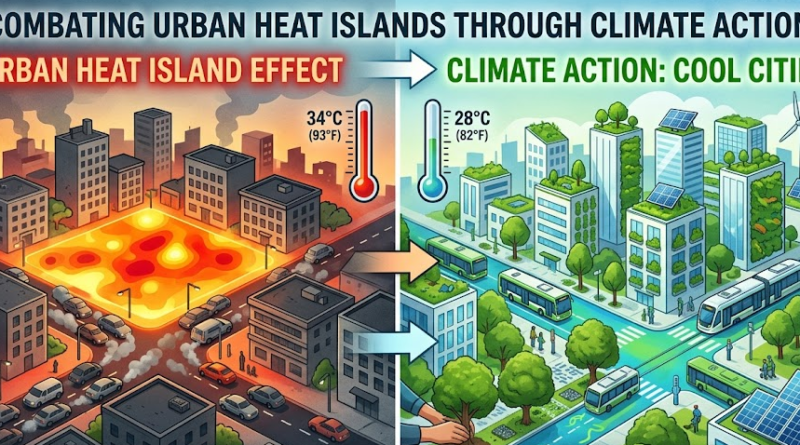
The Heat-Island Crisis in India
CHENNAI — As summer temperatures in most Indian cities frequently breach the 35°C mark, one of its busiest commercial hubs has become a case study in a growing urban nightmare: the Urban Heat-Island (UHI) effect.
While shoppers flock to textile and jewellery showrooms, the very systems designed to keep them cool—massive air conditioning units—are reportedly “blasting” hot air back onto the streets, creating a localized furnace. For newsdash.in, this story highlights the critical shift in India’s climate strategy from broad national goals to “street-level” survival plans.
Paradox: ACs as Heat Generators
Deena Hari Krishna of Auroville Consulting (a U.N.-backed center) warns that Chennai is one of most vulnerable cities.
- The Problem: The concentrated exhaust from thousands of AC units, combined with high building density, makes the area significantly hotter than the rest of the city.
- The Mitigation Strategy: Krishna suggests a shift toward Passive Cooling. This includes:
- Using mechanical fans to “suck out” hot air.
- Standardizing AC temperatures at 24–26°C.
- Integrating heat-resilience into the Chennai Third Master Plan, supported by global climate groups like C40 Cities.
The “Ownership” Gap in India’s Climate Plans
Despite most Indian States having State Action Plans on Climate Change (SAPCCs), implementation remains patchy. Nambi Appadurai of WRI-India notes that most plans lack “clear ownership.” However, a few states are leading the way:
- Tamil Nadu: At the forefront with the Tamil Nadu Green Climate Company (TNGCC), a nodal agency for all climate action.
- Odisha: Successfully implemented “Climate Budgets” to track every rupee spent on resilience.
- Kerala & Madhya Pradesh: Excelling in disaster management and knowledge platforms, respectively.
From Data to Action: The New Tools of Resilience
Experts point to a new era of “Climate-Led Development” where infrastructure is built with a heat lens.
- Integrated Planning: In Ratnagiri, Maharashtra, officials have scrapped separate climate documents, instead integrating resilience directly into the District Development Plan.
- The Digital Edge: Portals like the India Climate and Energy Dashboard (NITI Aayog & Vasudha Foundation) and the PM Surya Ghar portal are turning raw data into actionable policy for over 6 lakh users.
- Thane’s Heat Task Force: Uses a “Responsibility Matrix” to ensure different government departments actually talk to each other during a heatwave.
The 16th Finance Commission: A Game Changer?
A significant financial shift is on the horizon. Vishwas Chitale of CEEW points out that the 16th Finance Commission has recommended making heatwaves a nationally notified disaster.
The Impact: This move would unlock massive federal funding for cities to build heat-resilience infrastructure, moving heatwaves from a “seasonal nuisance” to a “national priority.”