
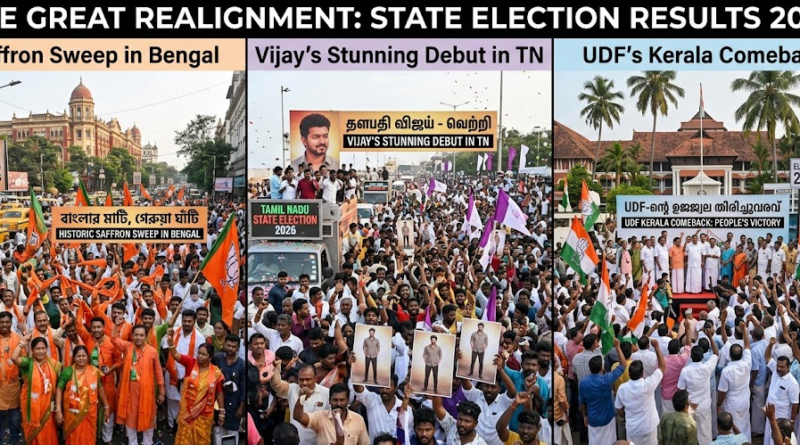
The Great Realignment: Saffron Sweep in Bengal, Vijay’s Stunning Debut in TN, and UDF’s Kerala Comeback
NATIONAL DESK — Monday, May 4, 2026, will be remembered as a watershed moment in Indian political history. From the shattering of the half-century-old Dravidian duopoly in Tamil Nadu to the Bharatiya Janata Party (BJP) capturing its “unfinished project” in West Bengal, the electoral map of India has been radically redrawn.
The verdict across four major battles reflects a pervasive theme of anti-incumbency and a hunger for “Third Front” alternatives.
1. Tamil Nadu: The ‘Thalapathy’ Disruption
In a result that has stunned political analysts, actor C. Joseph Vijay’s Tamilaga Vettri Kazhagam (TVK) emerged as the single largest party, securing 107 seats in the 234-member house.
- The Power of Charisma: Discarding a ₹200-crore-per-film career, Vijay’s 35% vote share has left the DMK (59 seats) and AIADMK (45 seats) reeling.
- A Hung Assembly: For the first time since 1952, Tamil Nadu faces a hung Assembly, with TVK falling just 11 seats short of the halfway mark.
- Giant Killers: CM M.K. Stalin and 14 of his Cabinet colleagues suffered defeats, marking a total rejection of the established Dravidian majors.
2. West Bengal: The Saffron Dawn
The BJP has achieved what it long considered its “ideological triumph,” winning a two-thirds majority (206 seats) to form its first-ever government in West Bengal.
- The Fall of Bhabanipur: In a symbolic blow, Chief Minister Mamata Banerjee lost her seat to Suvendu Adhikari by 15,105 votes.
- Breaking Myths: The BJP secured an all-time high vote share of 45.85%, making significant inroads into Kolkata and adjoining districts—areas previously considered Trinamool bastions.
- The Muslim Vote Split: Unlike previous years, the Muslim vote was fragmented between the Left-ISF, Congress, and the AJUP, which severely damaged the TMC’s chances.
3. Kerala: The UDF Rebound
Kerala’s “revolving door” politics returned with a vengeance as the United Democratic Front (UDF) ended 10 years of LDF rule.
- The Magnitude: The UDF bagged 102 seats, while the LDF was reduced to just 35.
- The Third Bloc: The BJP fundamentally realigned Kerala’s bipolar landscape by winning 3 seats (Nemom, Kazhakoottam, and Chathannoor) and emerging as a close second in six others.
- Cabinet Collapse: 13 LDF Cabinet Ministers were defeated, reflecting deep voter fatigue and anger over scandals and perceived executive arrogance.
4. Puducherry: The NDA Hold
Bucking the trend of total upheaval, the National Democratic Alliance (NDA), led by CM N. Rangasamy’s AINRC, retained power in the Union Territory.
- NDA Tally: 18 out of 30 seats (AINRC 12, BJP 4, AIADMK 1, LJK 1).
- TVK Entry: Vijay’s TVK also opened its account here with 2 seats, signaling its potential as a regional player beyond Tamil Nadu.
Consolidated Scoreboard: May 2026 Results
| State/UT | Total Seats | Leading/Winner | Major Opposition | Key Outcome |
| West Bengal | 294 | BJP (206) | TMC (80) | First BJP Govt in WB |
| Tamil Nadu | 234 | TVK (107) | DMK (59) | Hung Assembly; TVK as SLP |
| Kerala | 140 | UDF (102) | LDF (35) | UDF returns after 10 years |
| Puducherry | 30 | NDA (18) | INDIA (6) | NDA retains power |
This is not just a change of government; it is a change of culture. In West Bengal, the BJP has moved from the periphery to the core. In Tamil Nadu, the 51-year-old Vijay has proven that cinema and politics remain inseparable, yet he has managed to do what no other “Third Force” could do in 50 years—break the DMK-AIADMK lock. For the LDF in Kerala, the 10-year fatigue was insurmountable. The 2026 mandate is a loud cry for a “New Era.”