
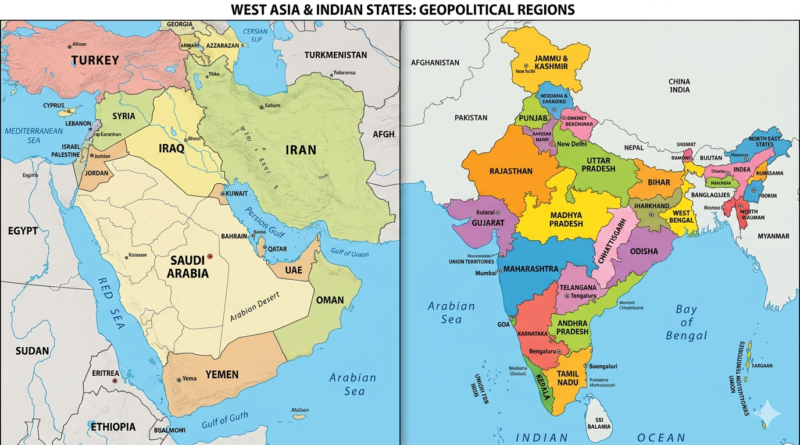
The Fiscal Fault Line: Why the West Asia Crisis is a ‘Tipping Point’ for India’s Debt-Ridden States
As the West Asia crisis drives global oil prices to $126 and disrupts trade, the Union Finance Ministry has issued a timely—and sobering—reality check. The “Monthly Economic Review” for April 2026 makes it clear: India’s battle for fiscal stability will not be won in New Delhi alone, but in the state capitals of Himachal, Punjab, and Kerala.
The Revenue Deficit Trap
The Ministry has highlighted a failure to maintain the “Golden Rule” of fiscal financing: a zero revenue deficit. When a state spends more on salaries, pensions, and interest than it earns, it loses the “degree of freedom” to handle shocks.
- The Debt Burden: Nine out of 18 large states are running revenue deficits. These states are effectively borrowing money not to build bridges or schools, but to pay for yesterday’s expenses.
- The Interest Nightmare: States like Punjab are now caught in a debt spiral, spending a staggering 22.8% of their revenue just on interest payments.
The “Surplus” Stars: Bihar and Odisha
In a significant shift, the report lauds states that are prioritizing “deliberate investment” over “fiscal stress.”
- The Odisha Model: While Odisha’s fiscal deficit is higher than the 3% norm, its 6.5% capital outlay (investment in infrastructure) marks it as a leader in productive spending.
- The Bihar Turnaround: For our readers in Patna, the news is cautiously optimistic. Bihar is among the eight states projected to have a revenue surplus (0.1%). By keeping its revenue books balanced, Bihar maintains the fiscal space needed to invest in development despite the global downturn.
The Centre-State Friction
The situation highlights a looming political and economic clash. As the Centre tries to “consolidate” (reduce its own debt), stressed states are likely to demand higher transfers.
- Reprioritizing vs. Begging: Deficit states face a brutal choice: cut spending on productive areas (like healthcare and education) or approach the Centre for a bailout at a time when the Centre’s own pockets are strained by the oil crisis.
The Global Shockwave
Why does the West Asia crisis matter for a state budget in Shimla or Bengaluru?
- Higher fuel prices increase the cost of government operations.
- Reduced consumption due to inflation lowers State GST collections.
- For states already at the edge, these “shocks” could lead to a total breakdown of public services.
The Bottom Line
The “Golden Rule” is no longer a theoretical suggestion; it is a survival manual. States like Odisha and Uttar Pradesh are building a cushion for the storm, while others are burning their furniture to keep the lights on. For India to remain resilient against the Trump-era volatility and the Persian Gulf standoff, the states must stop looking at the Centre as a permanent safety net and start fixing their own balance sheets.