
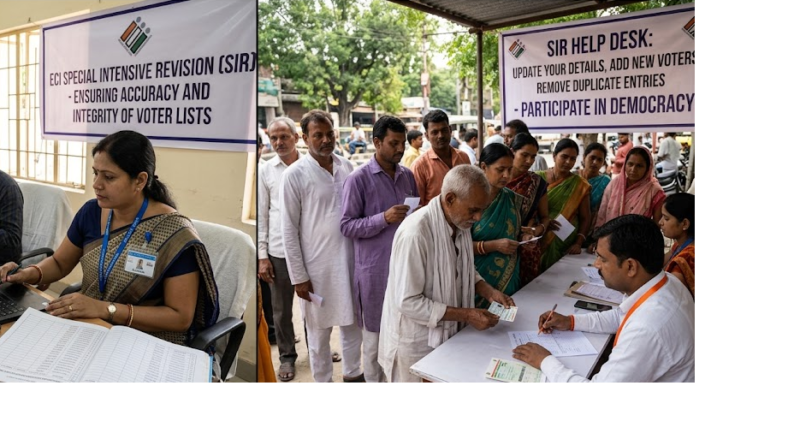
Supreme Court Green-Lights Election Commission’s Special Intensive Revision
NEW DELHI: In a landmark verdict that will have sweeping implications for the country’s democratic machinery, the Supreme Court on Wednesday threw its weight behind the Election Commission’s Special Intensive Revision (SIR) of electoral rolls, declaring that the “purity” of the voter list is the very bedrock of free and fair elections.
A Bench comprising Chief Justice of India Surya Kant and Justice Joymalya Bagchi dismissed petitions alleging that the massive Special Intensive Revision or voter-verification drive in Bihar was a covert citizenship screening exercise.
“Free and fair elections do not rest merely upon the mechanics of polling. They equally depend upon the integrity, accuracy, and purity of the electoral roll,” the Bench observed, adding that the poll panel’s actions were deeply rooted in its constitutional mandate under Article 324.
The Citizenship Question
Addressing the most contentious argument raised by the petitioners—that the Election Commission (EC) was overstepping by acting as a citizenship arbiter—CJI Kant, who authored the 124-page judgment, was unequivocal. The apex court ruled that since citizenship is a strict prerequisite for voting, the EC is well within its bounds to examine questions bearing upon it to determine inclusion or exclusion from the rolls.
However, the Court did not leave disenfranchised voters without a safety net.
In a crucial directive, the Bench ordered the EC to refer the names of voters who were present in the 2003 rolls but purged during the Bihar SIR on citizenship grounds to the Centre within four weeks. A competent authority under the Citizenship Act has been tasked with adjudicating these cases before the next Vidhan Sabha or local body elections. If proven to be citizens, their voting rights must be promptly restored.
Additionally, bona fide residents of Bihar whose names were wrongly struck off citing death, absence, or duplication have been granted the liberty to challenge the EC’s decision in court.
The Numbers: A Shrinking Electorate
The scale of the revision in Bihar was monumental. According to the data presented, the electoral roll shrank from 7.89 crore voters when the SIR was notified in June 2025, to 7.42 crore by the time the final roll was published on September 30. This massive purge of roughly 47 lakh names was justified by the Court as a necessary administrative clean-up.
The Bench noted that the poll panel had “cogent justifications” for the exercise. With over two decades having passed since the last intensive revision, the Court acknowledged that rapid urbanisation, migration, and unreported deaths had resulted in a highly defective, dynamic electoral roll that needed updating.
Ripple Effect Across 12 States
The Supreme Court’s stamp of approval on the Bihar model clears the runway for the EC’s ambitious Phase 2 of the SIR. This ongoing phase targets a colossal 51 crore voters across 12 States and Union Territories—including politically crucial battlegrounds like West Bengal, Tamil Nadu, and Kerala.
Safeguards Over Suffering
Dismissing arguments that the SIR caused undue harassment to the common man, the Bench expressed satisfaction with the safeguards put in place to prevent arbitrary exclusions.
The Court highlighted that the EC had introduced robust safety valves, including the use of Aadhaar as the 12th “indicative” document for citizenship verification, the transparent publication of the 65-lakh excluded electors list in Bihar, and the active involvement of booth-level political agents to assist citizens at the grassroots.