
SC Rejects TMC’s ‘Allegiance’ Theory: ‘All Poll Staff Belong to EC, Not Parties’
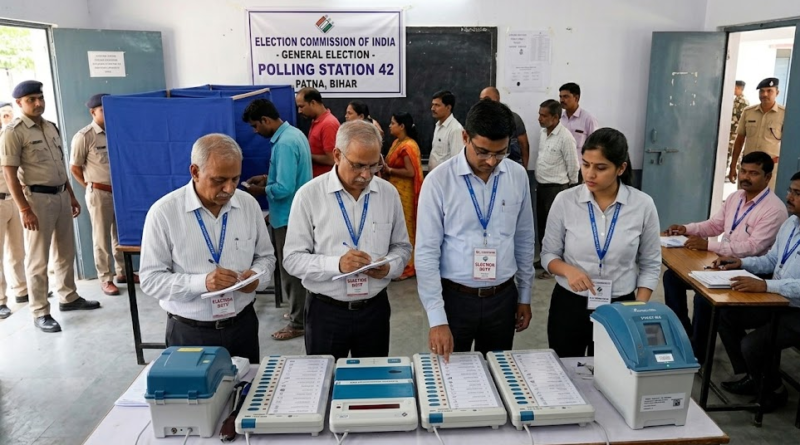
NEW DELHI — In a high-stakes special sitting just 48 hours before the West Bengal vote count, the Supreme Court has delivered a stern reminder of constitutional neutrality. On Saturday, a Special Bench dismissed a petition by the Trinamool Congress (TMC) that questioned the deployment of Central government employees at counting centres, calling the notion of political “allegiance” among government servants a “fallacy.”
The ruling effectively clears the decks for the May 4 counting process, upholding the Election Commission’s (EC) right to mix Central and State personnel to ensure the integrity of the results.
The ‘Fallacy’ of Political Loyalty
The heart of the TMC’s argument was that Central employees are “susceptible” to the influence of the BJP, while State employees should have proportionate representation. Justice P.S. Narasimha dismantled this premise:
“This is yet another fallacy… that those belonging to State government services have a different allegiance. These are but employees of the government. Give them some credit.”
The Court’s Logic: Once an officer is deployed for election duty, they are legally and operationally under the sole control of the Election Commission. Their previous employer—whether the Centre or the State—becomes irrelevant to their electoral duties.
The Clash Over the April 13 Circular
The legal battle centered on a circular issued by West Bengal’s Additional Chief Electoral Officer.
- The Rule: At least one counting supervisor and one assistant at every table must be a Central Government or Central PSU employee.
- TMC’s Stance: Represented by Kapil Sibal, the party called this a “textbook example of unjust executive action,” arguing it cast an unfair shadow of doubt on the integrity of State employees.
- The EC’s Stance: The poll body maintained that this was a standard measure to address “apprehensions of irregularities” and ensure a balanced, supervised counting environment.
Article 324: A ‘Wild Horse’?
In a sharp exchange, Kapil Sibal argued that the EC’s powers under Article 324 (superintendence and control of elections) cannot be a “wild horse” that allows the body to act on subjective whims without data.
However, Justice Joymalya Bagchi countered that the EC must make calls based on its “subjective satisfaction” on the ground, and it is not obligated to confer with political parties for every administrative decision regarding poll security.
Quick Comparison: The Legal Tug-of-War
| Feature | TMC’s Argument | Supreme Court’s View |
| Staff Loyalty | Central staff may favor the BJP; State staff are sidelined. | Employees are loyal to the Constitution/EC during polls. |
| Circular Goal | An insult to the State government’s neutrality. | A valid administrative tool to ensure grid stability and trust. |
| EC Power | Must be backed by data; cannot be a “wild horse.” | EC has autonomy for “subjective satisfaction” on the ground. |