
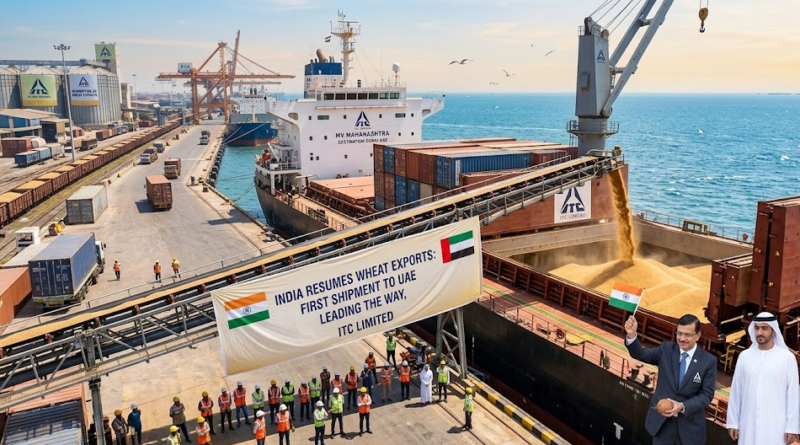
India Resumes Wheat Exports After Four-Year Hiatus
KANDLA, GUJARAT — In a major shift for global agricultural markets, Indian traders have resumed wheat exports for the first time since 2022. A combination of “mountainous” domestic stocks and a tightening global supply has finally made Indian wheat competitive on the world stage.
The first major move comes from consumer goods giant ITC, which has begun loading 22,000 metric tons of wheat at the Kandla port, destined for the United Arab Emirates (UAE).
Why the Export Window Opened Now
The resumption of exports is driven by a “perfect storm” of economic factors:
- Ample Domestic Stocks: Successive bumper harvests and high procurement by the Food Corporation of India (FCI) have left silos overflowing.
- Global Price Surge: Geopolitical tensions and crop failures in other major exporting regions (like Eastern Europe) have pushed global wheat prices higher, making Indian grain an attractive alternative.
- Firm Freight Rates: While usually a deterrent, current shipping logistics have favored short-haul shipments from India’s western ports to nearby markets in the Middle East and Southeast Asia.
Strategic Significance: The Asia-Middle East Corridor
Trade sources indicate that while these are “small shipments” compared to India’s pre-2022 volumes, they represent a vital re-entry into traditional markets.
- Primary Destinations: The UAE, Oman, and parts of Southeast Asia are the current focus.
- Logistics Advantage: Shipping from Kandla Port (Gujarat) offers a direct, cost-effective route to the Persian Gulf, allowing Indian traders to undercut long-distance competitors.
Background: The 2022 Ban
India, the world’s second-largest wheat producer, had banned wheat exports in May 2022 after a sudden heatwave shriveled crops, raising fears about domestic food security and soaring local prices. Since then, the government has maintained a cautious stance, prioritizing the Pradhan Mantri Garib Kalyan Anna Yojana (PMGKAY) and buffer stock requirements.
India’s return to the wheat market is a “relief valve” for both domestic storage problems and global food inflation. While the 22,000 tons being loaded by ITC is a drop in the bucket compared to global demand, it signals to the world that India is once again open for business.