
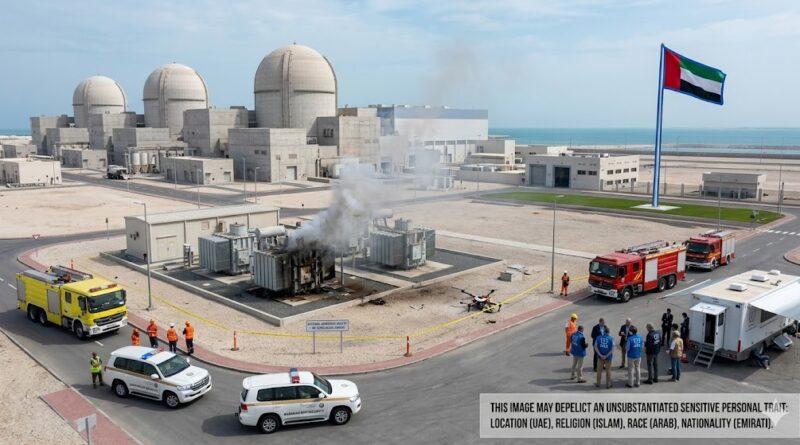
Drone Strike Targets UAE’s Barakah Nuclear Plant
Abu Dhabi/Dubai: A drone strike targeted the United Arab Emirates’ sole nuclear energy facility on Sunday, igniting an external electrical generator on its outer perimeter. While authorities confirmed that core systems remain safe and no radiation leak has occurred, the strike has severely strained the tenuous ceasefire in the regional war involving Iran, the US, and Israel.
Three drones breached UAE airspace via the western border; air defenses intercepted two, while the third struck an external generator. No casualties or radiological releases were reported. Core facility infrastructure remains secure.
The plant continues to run, though one reactor unit has been temporarily switched to emergency backup power. UAE officials have condemned the strike as an “unprovoked terrorist attack,” warning that the country retains the full right to respond.
Technical Impact and Nuclear Safety Measures
The strike targeted the sprawling $20 billion Barakah Nuclear Energy Plant located in the Al Dhafra region of Abu Dhabi. The Abu Dhabi Media Office and the Federal Authority for Nuclear Regulation (FANR) issued immediate statements to verify the status of the facility’s reactors:
“The competent authorities responded to a fire in an electric generator located outside the inner perimeter… there is no impact on radiation safety levels, and all precautionary measures have been taken.”
The IAEA’s Assessment
While local regulators reported normal operations across the board, the International Atomic Energy Agency (IAEA) noted a minor operational disruption. IAEA Director-General Rafael Mariano Grossi expressed “grave concern” over the escalation, revealing the following details:
- The fire cut off standard power to Unit 3, forcing the reactor to switch to emergency diesel generators for its cooling systems.
- Environmental radiation levels are being monitored continuously in coordination with Emirati authorities.
Regional Fallout: A Fragile Ceasefire at Risk
The strike marks the first time the four-reactor Barakah facility has sustained damage since the broader war erupted on February 28. While no group has claimed responsibility, the incident follows a period of intense friction over the Strait of Hormuz, a vital maritime energy chokepoint currently under a U.S. naval blockade.
Anwar Gargash, senior diplomatic adviser to the UAE President, stated:
“Whether carried out directly by those responsible or through one of their proxies, [this] represents a dangerous escalation and a dark development that violates all international laws and norms.”
In response, Iranian state media reported that its defense forces remain prepared for any potential counter-strikes, while diplomatic sources indicate that U.S. and Israeli military officials are closely coordinating options should the current truce collapse.
Fact File: The Barakah Nuclear Power Plant
| Parameter | Details |
| Location | Al Dhafra Region, Abu Dhabi, UAE |
| Project Cost | $20 Billion (Developed in partnership with South Korea) |
| Operational History | Commenced operations in 2020; currently the only active nuclear power station in the Arab world. |
| Energy Contribution | Designed to fulfill roughly 25% of the United Arab Emirates’ total electricity demands. |
| Non-Proliferation Status | Bound by a strict U.S. “123 Agreement,” under which the UAE imports all uranium and foregoes domestic enrichment. |
Internation Law and Loophole
The strike on the Barakah facility underscores a dangerous breakdown in international humanitarian law, which has struggled to adapt to the realities of asymmetric warfare. Under Article 56 of the Geneva Conventions, civil nuclear plants are classified as protected installations containing “dangerous forces,” making any attack that threatens a radioactive release a recognized war crime.
However, hostile actors increasingly exploit a critical loophole by targeting auxiliary infrastructure—such as external grids and backup generators—rather than the reinforced reactor cores.
The Blueprint for Survival
To prevent these legal safeguards from failing entirely, international experts advocate for sweeping institutional, technological, and diplomatic reforms. Legally, the Geneva Conventions must be amended to expand protections to a facility’s entire operational ecosystem.
Operationally, nuclear sites must upgrade from passive infrastructure to aggressive active defense, incorporating advanced Counter-Drone (C-UAS) electronic warfare systems and burying redundant power systems in reinforced underground bunkers. Finally, international frameworks must enforce strict state-sponsor liability, closing the proxy loophole by holding the supplier nations of advanced drone technology directly accountable for attacks on strategic civilian infrastructure.