
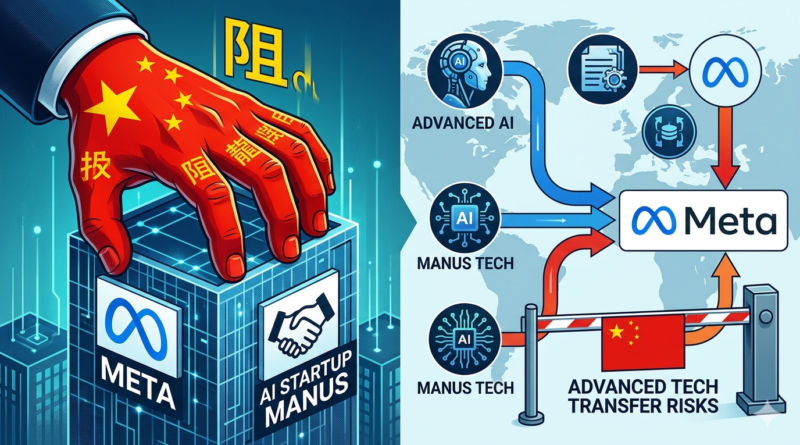
China Blocks Meta’s Bid for AI Startup ‘Manus’
HONG KONG — In a move that has stunned the global tech industry, Chinese regulators on Monday blocked U.S. social media giant Meta’s planned acquisition of the artificial intelligence startup Manus. The intervention represents a rare and aggressive move by Beijing to halt a deal involving a major American firm, signaling heightened sensitivity over the control of next-generation AI.
Unexpected Regulatory Intervention
The decision was announced by China’s top planning agency, which took the unusual step of reversing a deal that was reportedly in its final stages. While the agency did not provide an exhaustive list of reasons for the ban, it explicitly highlighted concerns regarding the “transfer of advanced technology” that could arise from the acquisition.
Industry analysts suggest that Manus—known for its breakthrough work in autonomous AI agents—may possess intellectual property that Beijing considers vital to its own national security and technological self-sufficiency.
The “Manus” Factor: Why Meta Wanted It
Manus has gained significant traction in the AI space for its “General Purpose AI Agent” technology, which is designed to handle complex, multi-step tasks across different software platforms. For Meta, the acquisition was seen as a key move to integrate advanced agentic capabilities into its “Llama” ecosystem and its broader metaverse ambitions.
By blocking this deal, China is effectively preventing Meta from consolidating more power in the AI agent market, while also keeping Manus’s technological “know-how” from being absorbed into a U.S.-controlled corporate giant.
A New Front in the Tech War
This block marks a shift in strategy. While the U.S. has frequently used export controls to prevent advanced chips from reaching China, Beijing is now increasingly using its Antitrust and National Security laws to prevent Western firms from acquiring promising startups that have a Chinese footprint or significant R&D presence in the region.
The move is likely to face criticism from Washington, further straining the already fragile tech-trade relationship between the two superpowers.