
The Quad Move to Break China’s Critical Mineral Monopoly
If you want to understand the future of global technology and critical minerals, look no further than the sidelines of this week’s 11th Quad Foreign Ministers’ Meeting. While diplomatic handshakes often yield little more than polite press releases, Tuesday’s developments signaled a seismic shift in the global supply chain: India and the United States have drawn a line in the sand regarding critical minerals.
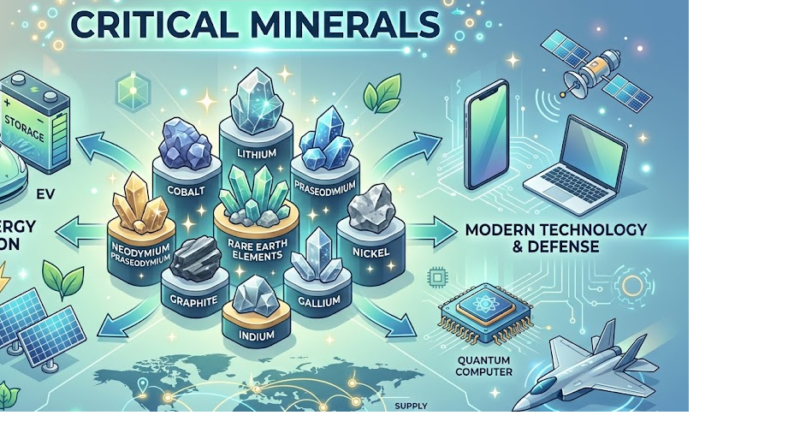
Following mounting anxieties over China’s restrictive export controls on rare earth elements and strategic metals—the lifeblood of everything from smartphones to fighter jets—New Delhi and Washington are moving aggressively to secure their own supply lines.
The Bilateral Push: “Securing the Supply”
The newly minted pact, officially titled “Securing of supply in the mining and processing of critical minerals and rare earths,” is not just a statement of intent; it is an operational roadmap.
The framework explicitly targets every link in the supply chain:
- Mining & Processing: Coordinated investments in raw extraction and refinement.
- Recycling: Developing advanced capabilities to recover critical metals from e-waste and scrap.
- Financing: Joint collaboration to fund these capital-intensive projects.
This agreement didn’t happen overnight. It is the culmination of high-level diplomatic groundwork laid during Prime Minister Narendra Modi’s visit to Washington in February 2025, where secure mineral routes were elevated to a “shared strategic priority.” It also builds on India’s entry into the U.S.-led Pax Silica initiative earlier this year on February 20, 2026.
The Quad’s $20 Billion War Chest
Beyond the India-U.S. bilateral agreement, the wider Quad alliance (Australia, India, Japan, and the U.S.) unveiled its own heavy-hitting initiative. The four nations are establishing a framework designed to mobilize approximately $20 billion in blended government and private-sector support.
The goal? To incubate critical mineral projects specifically located within Quad nations and operated by companies headquartered in these allied countries.
This is a direct response to the market shocks of 2025, when Beijing tightened its grip on rare earth exports following sweeping U.S. tariffs.
The U.S. isn’t just talking; it’s deploying unprecedented capital. According to the U.S. Embassy, Washington is already backing projects with over $30 billion in letters of interest, loans, and investments. This spans both domestic and international efforts, binding economic competitiveness directly to national security.
The Bottom Line: Harmonization and Urban Mining
What makes these frameworks truly viable is the commitment to regulatory alignment. Both the bilateral and Quad-level agreements emphasize harmonizing domestic laws to grease the wheels for cross-border investments and supply chain access, while tightening security controls to keep adversaries out.
Perhaps most crucially, the Quad is focusing heavily on “urban mining”—recovering critical minerals from e-waste. By prioritizing the recycling of existing scrap materials within partner countries, the alliance is working to build a closed-loop system that reduces reliance on virgin mining entirely.
The era of unipolar dominance in critical minerals is being challenged. For tech supply chains, the map is officially being redrawn.