
The Quad Sets Sail: A New Security Architecture for the Indo-Pacific’s Troubled Waters
While the headline out of this week’s Quad Foreign Ministers’ Meeting was critical minerals, the real muscle was flexed at sea. Facing down dual crises—a conflict-ridden Persian Gulf and a hyper-militarized South China Sea—the alliance of India, the U.S., Japan, and Australia has pivoted from diplomatic dialogues to operational maritime strategy.
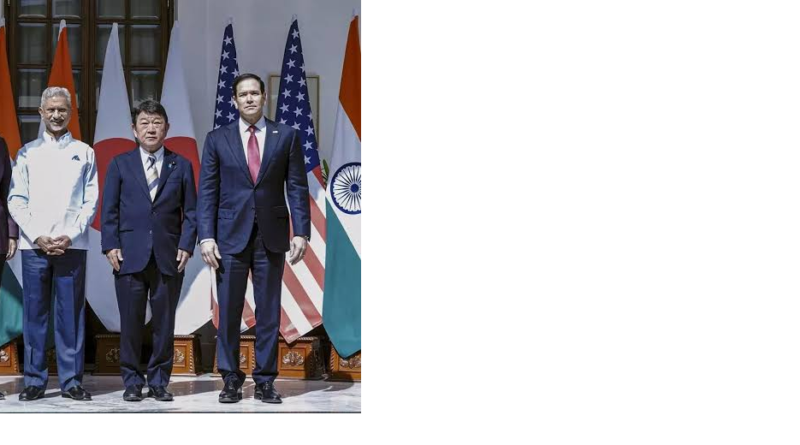
The message delivered on the lawns of Hyderabad House by External Affairs Minister S. Jaishankar and U.S. Secretary of State Marco Rubio was unequivocal: the era of passive observation in the Indo-Pacific is over.
Eyes Everywhere: Expanding Domain Awareness
The Quad announced two major security frameworks that essentially weave the four nations’ naval and coast guard assets into a unified grid:
- The Indo-Pacific Maritime Surveillance Collaboration: This initiative networks the surveillance capabilities of all four countries, creating a seamless, intelligence-sharing blanket across the region to monitor maritime traffic and coordinate emergency operations.
- Expansion of Maritime Domain Awareness: Building on previous efforts, this will now provide near real-time commercial tracking data to allied nations throughout the Indo-Pacific.
If a vessel goes “dark” or acts aggressively in international waters, the Quad will now know about it almost instantly—and share that data with regional partners.
The Chokepoint Showdown: Hormuz and the South China Sea
The immediate catalyst for this naval integration is the escalating threat to global trade routes.
Earlier this month, Iranian Foreign Minister Seyed Abbas Araghchi boldly claimed that the Strait of Hormuz is not an international waterway, implying Iran has no obligation to follow the UN Convention on the Law of the Sea (UNCLOS). The Quad’s joint statement hit back directly, condemning recent attacks on commercial shipping by Iran-backed Houthi militias in the Red Sea and demanding absolute adherence to UNCLOS in both Hormuz and the South China Sea.
Look closely at Mr. Jaishankar’s comments on the need for “safe and unimpeded maritime commerce.” He specifically called out growing collaboration not just in surface surveillance, but in undersea cables and logistics networks. The Quad is preparing for a world where critical infrastructure—both physical and digital—is actively targeted by state actors.
‘Quad at Sea’ and Energy Security
To operationalize these agreements, Secretary Rubio announced that India will host the next iteration of the “Quad at Sea” mission. This unique deployment will bring together the Coast Guards of all four nations onto a single ship for joint operations—a highly symbolic and practical demonstration of interoperability.
Simultaneously, the grouping launched the Indo-Pacific Energy Security Initiative, designed to insulate regional partners from the very supply shocks occurring in the Middle East by boosting regional energy resilience and conducting emergency response exercises.
Beijing’s Predictable Pushback
While Quad officials were careful to state these initiatives are “not aimed at any other regional powers,” the subtext is impossible to ignore. Within hours, Chinese Foreign Ministry spokesperson Mao Ning took to the podium in Beijing to reiterate China’s opposition to the “creation of exclusive small cliques.”