
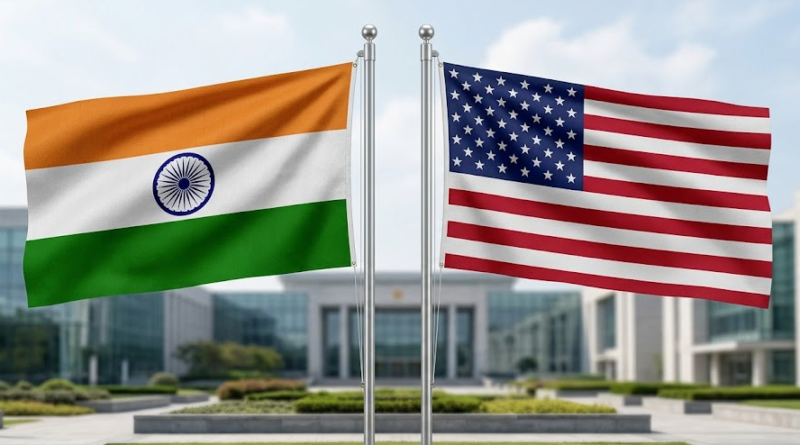
Rubio Anchors India at the Heart of U.S. Indo-Pacific Strategy Amid Quad Push
NEW DELHI — Reaffirming New Delhi’s critical position in Washington’s geopolitical calculus, U.S. Secretary of State Marco Rubio kicked off a crucial four-day visit to India on Saturday by meeting Prime Minister Narendra Modi and formally inviting him to the White House later this year.
The visit sets the stage for a high-stakes week of diplomacy, culminating in the Quad Foreign Ministers’ Meeting (FMM) on Tuesday, where Rubio will be joined by his Australian and Japanese counterparts.
Bilateral Roadmap and Global Summits
Secretary Rubio’s meeting with Prime Minister Modi focused on sustaining the momentum of India-U.S. cooperation across defence, strategic technologies, and energy security. According to the Press Information Bureau (PIB), Rubio credited PM Modi and U.S. President Donald Trump as the primary drivers of this revitalized engagement.
The diplomatic calendar for the two leaders is already filling up. Prime Minister Modi—who last visited the Trump White House in February 2025—is expected to cross paths with the U.S. President at the G-7 outreach summit in Evian, France, this June, before traveling to Mar-a-Lago for the G-20 summit in December.
Energy Security and the Middle East
A significant portion of the bilateral dialogue centered on global stability, particularly the ongoing conflict with Iran. U.S. State Department spokesperson Tommy Pigott noted that Rubio assured New Delhi that Washington would “not let Iran hold the global energy market hostage.” In a bid to secure India’s supply lines, the U.S. pitched its own energy products as a viable diversification strategy.
In response, Prime Minister Modi maintained New Delhi’s traditional stance of strategic autonomy, reiterating a call for the “peaceful resolution of conflicts through dialogue and diplomacy.”
The Quad Equation: Renewal Amid Underlying Frictions
While Rubio emphasized his mission to “renew” the Quad—calling the upcoming FMM a “tangible sign” of India’s vital role in the Indo-Pacific—the broader alliance faces undeniable headwinds.
Tuesday’s gathering marks the third FMM since President Trump’s return to office. However, the much-anticipated Quad Summit, slated to be hosted by India for the past two years, remains unscheduled. This delay underscores lingering bilateral strains over American tariffs, sanctions, and visa restrictions. Further complicating matters are persistent claims from Washington that it mediated a 2025 India-Pakistan ceasefire—an assertion New Delhi has firmly denied.
The Visa Paradox: Fast-Tracks vs. New Restrictions
The complexities of the India-U.S. relationship were perhaps most visible on the consular front. On Saturday, Rubio inaugurated a new ‘Support Annexe Building’ at the U.S. Embassy, announcing an upcoming priority visa service for Indian business and investment travelers.
Yet, as a veteran observer of U.S.-India ties must note, the timing presents a stark contrast. The inauguration coincides with a wave of stringent new U.S. restrictions on H1-B visas. More disruptively, new regulations now mandate that Permanent Resident Card (Green Card) applicants must leave the U.S. to complete their processing in their home countries—a move threatening considerable upheaval for thousands of Indian professionals currently working in America.
Secretary Rubio concluded his Saturday engagements at an evening reception hosted by Mr. Gor, attended by key Indian officials including External Affairs Minister S. Jaishankar, Foreign Secretary Vikram Misri, and Delhi Lieutenant-Governor Taranjit Singh Sandhu. Rubio and Jaishankar are slated for comprehensive bilateral talks on Sunday.