
Rewriting the Textbooks: Indian Scientists Create First-Ever Carbon-Free “Ferrocene” Sandwich
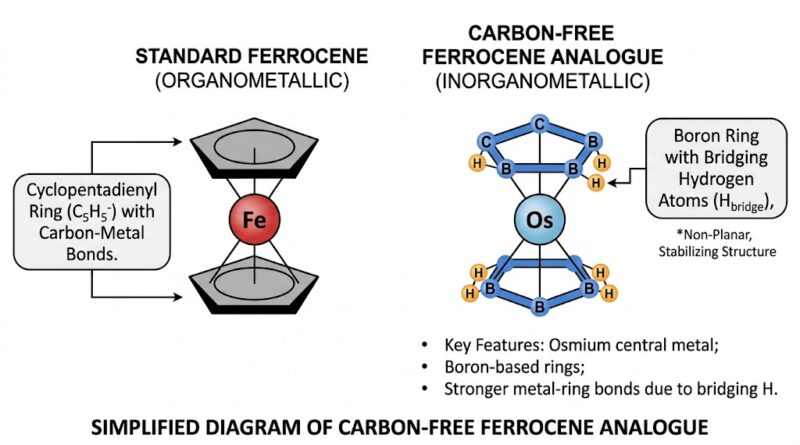
For over seven decades, ferrocene has been a certified legend in the chemistry world. Discovered in the mid-20th century, this molecular “sandwich”—a single iron atom securely squeezed between two flat carbon rings—practically launched the entire field of organometallic chemistry, altering the course of medicine, plastics, and materials science.
Ever since, chemists have chased a seemingly impossible holy grail: Can you build this iconic sandwich structure without using a single atom of carbon?
According to a groundbreaking study published in the journal Science, a team of Indian researchers from IIT-Madras and the Indian Institute of Science (IISc), Bengaluru, have finally done it.
Out with Carbon, In with Boron and Osmium
To replace carbon, the researchers looked right next door on the periodic table to boron. While boron is famous for its ability to mimic carbon’s ring-forming habits, getting those rings to perfectly hold a metal atom in a stable sandwich without collapsing had eluded scientists for generations.
By utilizing advanced computer modeling, the team discovered that iron wasn’t the right fit for a pure-boron sandwich. Instead, they zeroed in on osmium—a heavy transition metal from the same chemical family as iron.
The Recipe for a Breakthrough:
- The Mix: Scientists reacted an osmium-bromine precursor compound with an excess of a borane-dimethyl sulphide reagent.
- The Heat: The mixture was heated at 100°C for a steady eight hours.
- The Result: The team successfully isolated a stable, colorless solid—[Os(η5-B5H10)2]—the world’s first purely inorganic ferrocene analogue.
How the New Sandwich Compares
| Feature | Classic Ferrocene | The New Analogue |
| Center Metal | Iron (Fe) | Osmium (Os) |
| The “Bread” (Rings) | Carbon-based ($C_5H_5$) | Boron & Hydrogen-based ($B_5H_{10}$) |
| Ring Structure | Flat | Domed with bridging hydrogen atoms |
| Bond Strength | Strong | Significantly Stronger |
The Hydrogen Trick: Why It’s Actually Better
When the team analyzed the crystal structure using X-ray diffraction and NMR spectroscopy, they found something fascinating. Unlike the completely flat carbon rings in original ferrocene, these new boron rings feature bridging hydrogen atoms nestled between the boron atoms.
These tiny hydrogen bridges act like molecular lenses, bending and redirecting the ring’s electron orbitals straight toward the central osmium atom. This unique architecture creates a bond that is actually stronger than the one in classic ferrocene, allowing the molecule to remain stable at much higher temperatures.
A New Era for “Inorganometallics”
This discovery completely shatters the old rulebook stating that stable sandwich architectures belong exclusively to organic, carbon-based chemistry.
“Just as ferrocene started a new era in organometallics, these results will start a new era in inorganometallics and will be a part of textbooks of inorganic chemistry. Our efforts are on to study the reactions of these new compounds.”
— Sundargopal Ghosh, Chemistry Professor, IIT-Madras
Beyond earning a guaranteed spot in future chemistry textbooks, this breakthrough opens massive real-world avenues. It paves the way for creating highly resilient, ultra-stable catalysts for industrial chemistry. Furthermore, it unlocks new possibilities in 2D boron chemistry, meaning metal-sandwiched, multi-layered materials for next-gen electronics could soon become a reality.
It’s not every day you get to witness a literal textbook-rewriting moment. By swapping carbon for boron, these researchers didn’t just build a new molecule—they opened a gateway to an entirely new class of matter.