
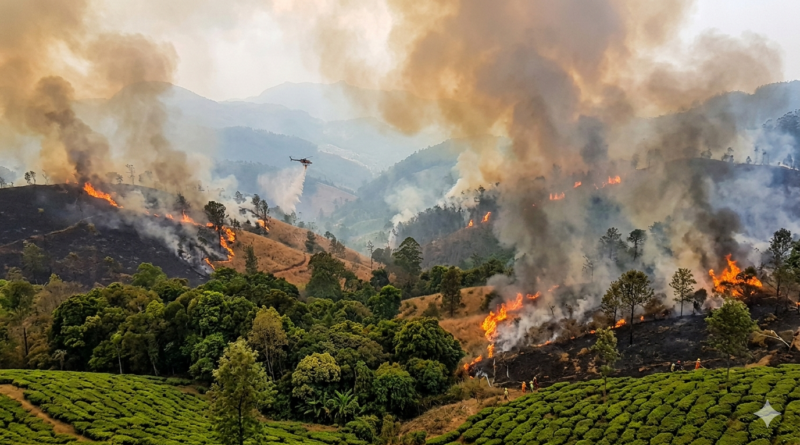
Massive Forest Fires Ravage Nilgiris and Mudumalai Tiger Reserve; IAF Helicopters Deployed
THE NILGIRIS — The Tamil Nadu Forest Department is currently locked in a high-stakes battle against multiple massive forest fires tearing through the Nilgiris Forest Division and the Mudumalai Tiger Reserve (MTR). The blaze, which has already destroyed hundreds of acres of pristine forest land, is threatening one of India’s most biodiverse regions.
Multiple Fronts: Singara, Masinagudi, and Parson’s Valley
The crisis escalated after fire incidents were reported across several critical ranges. According to Forest Department officials, the most intense flames are currently concentrated in:
- Singara and Masinagudi Forest Ranges (within the Mudumalai Tiger Reserve)
- Parson’s Valley
- Wenlock Downs Reserve Forest (where the first major report surfaced on April 15)
The fire in the Wenlock Downs area has been particularly difficult to contain due to the rugged terrain and dry weather conditions, which have allowed the flames to spread rapidly across the grasslands and shola forests.
IAF Joins “Operation Firefight”
In a significant escalation of the containment effort, the Indian Air Force (IAF) has been called in to assist. Helicopters equipped with “Bambi Buckets” were deployed from the Sulur Air Force Base in Coimbatore to perform aerial water drops over the most inaccessible parts of the Parson’s Valley Range.
On the ground, a massive coordinated effort is underway involving:
- Local Foresters and Personnel
- Eco-Development Committee (EDC) members
- Local volunteers and tribal communities
Environmental Toll
While the full extent of the damage is still being assessed, officials confirm that hundreds of acres of forest have already been reduced to ash. The fires pose a severe threat to the local wildlife, including elephants, tigers, and the endemic Nilgiri Tahr, as well as the unique “shola-grassland” ecosystem which acts as a natural water catchment for the region.
Authorities are currently investigating the cause of the fires, with dry biomass and high temperatures cited as major contributing factors.