
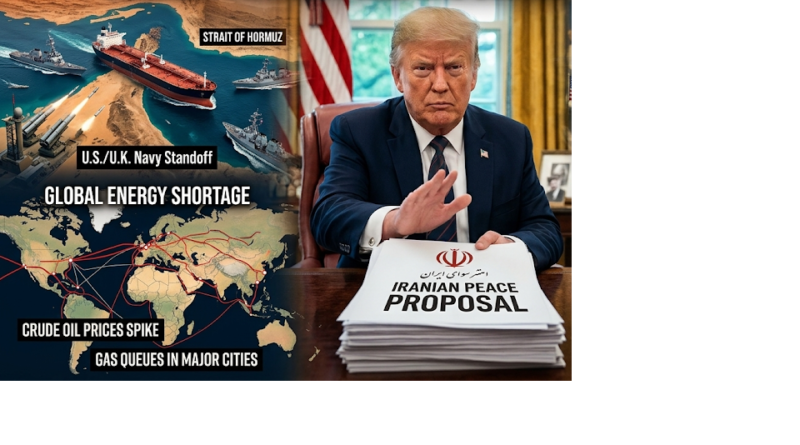
The Ceasefire Crumbles: U.S.-Iran Hostilities Reignite Over the Strait of Hormuz
The fragile peace established by the June 17 Memorandum of Understanding (MoU) between Washington and Tehran has officially unraveled. Speaking at a NATO summit in Ankara, Turkiye, U.S. President Donald Trump declared the ceasefire “over,” accusing Tehran of daily violations. In response, Iran asserted that American “violations” have rendered core provisions of the agreement ineffective.
The Catalyst: Flashpoint in the Strait of Hormuz
At the core of this sharp escalation lies a high-stakes struggle over control and navigation rights in the Strait of Hormuz—the world’s most critical oil transit chokepoint.
- Route Dispute & Tanker Attacks: Iran instructed commercial vessels to use a “designated route” along its coast in coordination with local authorities. Over the weekend, three commercial tankers operating along an alternative route off the Omani coast were attacked:
- M/T Al Rekayyat (Marshall Islands-flagged)
- M/T Wedyan (Saudi Arabia-flagged)
- M/T Cyprus Prosperity (Liberian-flagged)
- Revocation of Sanctions Waiver: Following the tanker strikes, the U.S. immediately revoked a key sanctions waiver—previously granted under the MoU—that allowed the sale of Iranian crude oil.
Kinetic Escalation: Heavy Strikes in the Persian Gulf
The economic retaliation quickly escalated into direct military exchanges, marking the second major clash between U.S. and Iranian forces since the June 17 agreement was signed.
U.S. CENTCOM Offensive (July 7)
U.S. Central Command executed precision strikes hitting over 80 targets across southern Iran. The operation targeted:
- Air defense systems and command-and-control networks
- Coastal radar sites and anti-ship missile batteries
- More than 60 Islamic Revolutionary Guard Corps (IRGC) small boats in and near the strait.
Iranian Response & Casualties
Iranian state media confirmed that U.S. strikes in Bandar Abbas and Bushehr resulted in the deaths of eight military personnel. In retaliation, Tehran claimed to have targeted 85 U.S. military assets across the Persian Gulf.
Warning of continued action, President Trump stated: “We’re gonna hit ‘em hard tonight… It is just a waste of time dealing with them.”
Escalation Ledger at a Glance
| Factor | Event / Action Taken |
| Immediate Trigger | Attack on 3 commercial tankers along the Omani coast route |
| Economic Response | U.S. revokes Iranian oil sales sanctions waiver |
| U.S. Military Action | CENTCOM strikes 80+ targets & 60+ IRGC small craft |
| Iranian Response | Retaliatory targeting of U.S. assets; 8 military personnel killed |
| Diplomatic Status | Trump declares ceasefire “over”; Iran cites MoU as “ineffective” |
Global Reaction: India Urges Restraint
The rapid escalation has alarmed major energy-importing nations dependent on Persian Gulf trade routes. Expressing deep concern over the fresh targeting of commercial shipping in the Strait of Hormuz, India’s Ministry of External Affairs (MEA) issued an official call for restraint:
“We urge the parties to return to dialogue and diplomacy to achieve a peaceful and lasting solution to the conflict.”
The Structural Flaw of Interim Ceasefires
This rapid collapse underscores a glaring reality: an interim ceasefire that leaves primary transit rights ambiguous in a narrow maritime corridor is inherently unstable. By tying oil sanctions waivers to maritime compliance while both sides maintain conflicting definitions of legal navigation in the Strait of Hormuz, the June 17 MoU created a tactical minefield. Without clear operational guidelines for international shipping, it only took one round of tanker strikes to collapse months of diplomatic maneuvering back into open warfare.