
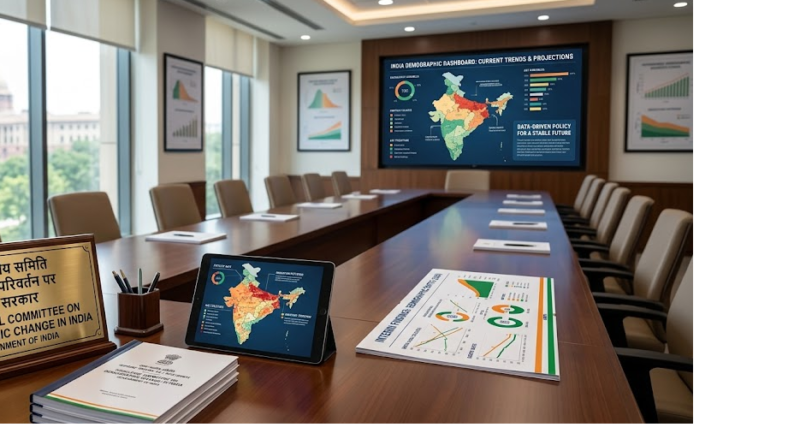
Redrawing the Population Map: The Stakes Behind India’s New Demographic Panel
Population data is rarely just about numbers; it is about political power, national security, and social fabric. Yesterday, Union Home Minister Amit Shah announced the formal operationalization of a high-level committee designed to investigate “unnatural demographic changes” across the country, specifically pointing to illegal immigration.
This move follows through on a major policy commitment made by Prime Minister Narendra Modi during his Independence Day address on August 15, 2025. In the words of the Home Minister, illegal infiltration isn’t just an administrative glitch—it is a “very big challenge for the present and future of any nation,” threatening everything from local tribal societies to core national sovereignty.
The Mandate: Beyond Documentation to Deportation
Headed by retired Supreme Court Judge Prakash Prabhakar Navlekar (83), this high-level panel has been given a strict one-year timeline to submit its comprehensive findings, with a maximum six-month extension if required.
Unlike standard bureaucratic study groups, this committee has been handed an explicitly operational terms of reference:
- Scientific Evaluation: Map and analyze patterns of abnormal population shifts, specifically focusing on religious and social communities where data deviates drastically from broader local averages.
- The Blueprint for Deportation: Establish a permanent, streamlined, and legally sound operational mechanism to identify, detain, and deport undocumented immigrants.
- Population Stabilization: Propose institutional safeguards to ensure long-term balance, particularly in sensitive border zones and regions with vulnerable indigenous populations.
A Heavyweight Committee
To ensure the findings carry legislative weight, New Delhi has stacked the panel with veteran administrators, economic minds, and security experts:
| Member | Profile / Role |
| Justice P. P. Navlekar (Retd.) | Chairman; Former Supreme Court Judge |
| Durga Shanker Mishra | Member; Retired IAS Officer & Admin Expert |
| Balaji Srivastava | Member; Retired IPS Officer & Security Specialist |
| Dr. Shamika Ravi | Member; Economist, Prime Minister’s Economic Advisory Council |
| The Census Commissioner | Member |
| Joint Secretary (Foreigners-I), MHA | Member Secretary |
The Macro Paradox: Shifting Demographics vs. Falling Birth Rates
What makes this development particularly fascinating to watch from an editorial standpoint is the broader macro-demographic backdrop of India in 2026. The committee’s launch arrives right in the middle of India’s ongoing digital Census exercise, which is on track to wrap up in 2027—the first official population count since 2011.
While the government zeroes in on regional spikes caused by “unnatural factors,” the country’s baseline demographic momentum is actually slowing down significantly.
The Macro Reality Checklist:
- Crashing Birth Rates: The latest Sample Registration System (SRS) data reveals India’s national birth rate dropped from 21 in 2014 down to 18.3.
- Below Replacement Level: The National Family Health Survey (NFHS-V) confirmed India’s Total Fertility Rate (TFR)—the average number of children born per woman—stands at 2.0. This places India safely below the official replacement rate of 2.1 required to maintain stable long-term numbers.
The Policy Road Ahead
This dynamic sets up a deep administrative challenge. While India as a whole is successfully stabilizing its population growth, localized “abnormal” spikes are altering the political and social equilibrium in sensitive border states and tribal pockets.
By linking demography directly to national security and social structure, the government is signalling that the Navlekar Committee’s report won’t just sit on a shelf. When published in 2027, its recommendations are highly likely to reshape India’s border infrastructure, citizenship tracking mechanisms, and federal-state coordination frameworks for decades to come.