
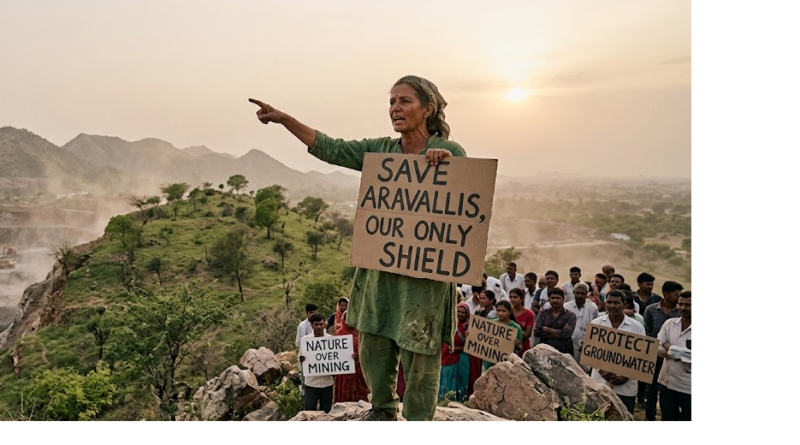
Expert Panel to Include Public Input on Aravalli Hills Conservation
NEW DELHI — The Supreme Court of India has altered course on the legal demarcation of the ecologically sensitive Aravalli Hills conservation. A Bench headed by Chief Justice Surya Kant clarified that the high-powered expert committee tasked with defining the Aravallis must not function behind closed doors. Instead, it must actively engage in consultations with environmental scientists, foresters, and the public at large.
The apex court clarified that while the committee should remain compact and functional (ideally limited to 5–7 core members) to avoid becoming unwieldy, it must collaborate deeply with outside experts to draw a final, foolproof roadmap for regulated mining and conservation.
The Backdrop: Why the Court Intervened
This latest directive stems from a massive public furore and an explosive regulatory blind spot uncovered by the court itself.
In November 2025, the Supreme Court originally upheld a government definition that restricted the legal identity of the Aravallis to:
- Landforms with an elevation of 100 metres or above.
- Hill clusters and slopes located within 500 metres of each other.
However, after recognizing the catastrophic ground reality, the Supreme Court took up the case again suo motu (on its own motion) and stayed its own November judgment.
The Math That Shocked the Bench
When the “100-metre threshold” was strictly mapped out against the true topography of the region, the results revealed a devastating regulatory lacuna:
[Total Documented Hills in Rajasthan were 12,081 Hills. Hills Protected Under 100m Rule were mere 1,048 Hills (Only ~8.7%).
Under the previous definition, over 11,000 lower hills and hillocks would be stripped of all environmental protection. This would effectively hand the vast majority of the landscape over to unregulated, aggressive mining operations, threatening the “green lungs” of Northwest India.
The Court’s New Directive
Chief Justice Surya Kant emphasized that the expert panel will operate directly “under the umbrella” and supervision of the Supreme Court to ensure maximum accountability.
| Committee Mandate | Composition Strategy | Core Objectives |
| Public & Expert Input | Core panel of 5–7 members from different walks of life. | Scientifically define the geographical contours of the Aravalli system. |
| Collaborative Outreach | Broad consultations with independent environmentalists, scientists, and foresters. | Create an airtight framework specifying permissible vs. prohibited activities. |
| Balanced Mining Rules | Inclusion of specialized regulatory mining experts where law permits. | Resolve whether the gaps between hill clusters can be safely regulated without breaking ecological continuity. |
What This Means for Mining Lease Holders: The Supreme Court has made it clear that the current freeze on fresh or renewed mining leases across Delhi, Haryana, Rajasthan, and Gujarat will remain firmly in place. No relief will be granted to mining companies until this new, public-inclusive scientific assessment reaches its logical finality.