
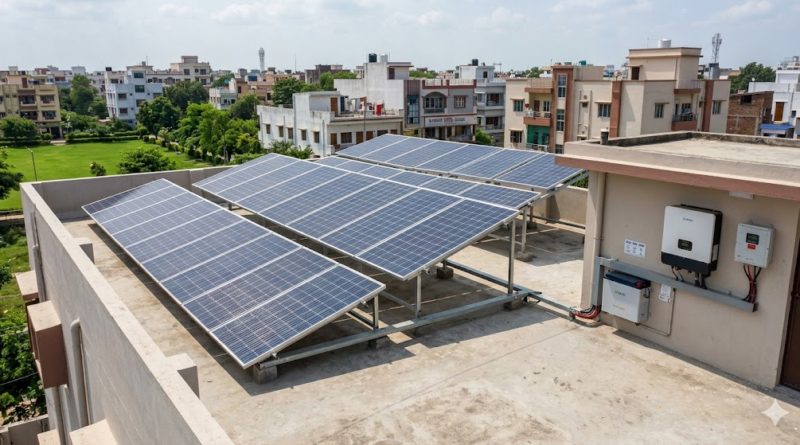
India’s Rooftop Solar Capacity Crosses 20.8 GW in Historic 123% Surge Driven by Household Scheme
NEW DELHI — India’s decentralized green energy transition is moving at an unprecedented pace. The nation’s cumulative rooftop solar capacity has officially hit 20.8 GW, powered by a historic record-breaking addition of 7.1 GW of new installations. This remarkable growth represents a staggering 123% year-on-year increase, indicating a massive shift in how the country’s grid is powered.
Unlike utility-scale solar projects that require vast tracts of land, these photovoltaic systems are installed directly on home, commercial, and institutional roofs. The newest data shows that the ultimate catalyst for this boom isn’t giant heavy industries—it is ordinary citizens.
Residential Sector Leads the Charge
In a major shift for the clean energy landscape, the residential sector accounted for 76% of all new rooftop solar installations.
The primary policy engine behind this consumer revolution is the central government’s flagship program: PM Surya Ghar: Muft Bijli Yojana. Approved by the Union Cabinet on February 29, 2024, with a massive financial outlay of ₹75,021 crore, the scheme targets solarizing one crore (10 million) households by FY 2026-27 while promising up to 300 units of free electricity per month.
Progress Snapshot: As of December 9, 2025, a total of 1,945,758 rooftop systems had already been deployed under the scheme, successfully covering 2,435,196 households nationwide.
State Leaderboard: The Top Performers
A closer look at the geographical distribution reveals an intense race among states to secure solar dominance. Three states alone accounted for nearly half of all new deployments, while regions in the northeast are also logging significant progress.
| State / Region | Share of 2025 New Deployments | Key Milestone / Metric |
| Maharashtra | 16% | Tied for first place in new capacity additions |
| Gujarat | ~16% | Strong historical footprint continuing momentum |
| Uttar Pradesh | 15% | Emerging fast-track player in northern India |
| Assam | — | Registered 63,887 active installations under PM Surya Ghar |
The New Utility-Led Wave
To sustain this incredible momentum and onboard poorer or more complex household demographics, the government has cleared a massive structural upgrade.
The newly introduced Utility-Led Aggregation (ULA) model received approvals for over 1.3 million additional rooftop solar systems across 10 states and Union Territories. Under this mechanism, local power distribution companies (discoms) aggregate consumer demand and oversee deployment directly, simplifying the installation and financial onboarding process for homeowners.
- Rollout Underway: Discom-driven installations have officially commenced in Odisha, Andhra Pradesh, Telangana, and the UT of Dadra and Nagar Haveli and Daman and Diu.
- Next Phase Expansion: Seizing on the policy’s early success, Bihar, Kerala, Jammu and Kashmir, and Rajasthan have formally submitted proposals to join the ULA framework.
As distribution utilities take over the execution and quality control barriers, industry experts anticipate that India’s rooftop ecosystem is on track to smash its target of 10 million solar-powered homes ahead of schedule.