
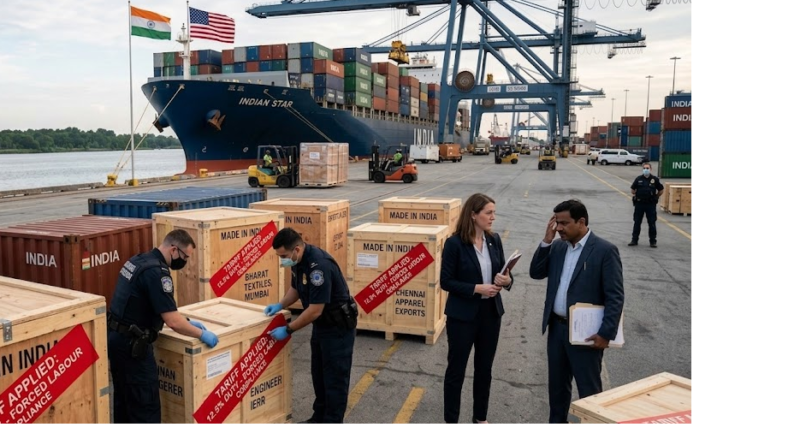
U.S. Proposes 12.5% Tariff on India Over ‘Forced Labour’ Supply Chains Amid Fragile Trade Talks
NEW DELHI — In a move that could significantly disrupt global supply chains and complicate ongoing diplomatic negotiations, the United States has proposed a sweeping 12.5% tariff on imports from 54 countries, placing India squarely in the crosshairs.
The mandate, spearheaded by the Office of the U.S. Trade Representative (USTR), accuses these nations of failing to implement and effectively enforce bans on the importation of goods produced using forced labor. The findings stem from a sweeping Section 301 investigation launched under the U.S. Trade Act of 1974 this past March, designed to penalize trade partners the U.S. views as complicit in unfair labor practices.
“The results of this investigation indicate that the acts, policies and practices of India related to the failure to impose and effectively enforce a forced labour import prohibition are unreasonable and burden or restrict U.S. commerce,” the USTR report declared.
A Calculated Trade Weapon?
Trade analysts and legal experts view this latest tariff proposal as a strategic pivot by Washington. In February, the U.S. Supreme Court struck down a controversial slate of reciprocal tariffs—including a massive 50% levy specifically targeting India—imposed by former President Donald Trump.
With those aggressive unilateral tariffs ruled unconstitutional, the Section 301 investigation serves as an alternative tool to exert pressure on global markets while technically rooting the penalties in human rights and labor compliance.
The proposed 12.5% levy places India in the same high-risk tariff bracket as its fiercest manufacturing competitors, including China, Bangladesh, Vietnam, Malaysia, and Thailand.
The Economic Fallout for Indian Exporters
While the USTR’s proposal is not yet final, its potential economic impact on Indian manufacturing is severe. The plan does offer a slight concession: a separate “textile mechanism” that would permit a designated volume of apparel and textile goods to enter the U.S. at a reduced tariff rate. However, the broader implications remain daunting.
Agneshwar Sen, Trade Policy Leader at EY India, warned that the consequences for India’s export economy could be multidimensional.
“In the near term, exporters in labour-intensive industries such as textiles, garments, carpets, leather products, and brassware could face at least an additional 10% levy under Section 301, adding to their existing tariff exposure,” Sen explained. He emphasized the urgency for India to mount a robust defense, urging the government and industry leaders to “submit detailed written representations by July 6 and participate proactively in the July 7 public hearing to challenge these conclusions.”
Diplomacy Under Pressure
The timing of the USTR’s announcement is highly sensitive. It arrives just as a U.S. negotiating team is on the ground in India for a critical three-day diplomatic visit concluding June 4.
The primary objective of this summit is to finalize the contours of an Interim Agreement on trade—a precursor to a much broader Bilateral Trade Agreement (BTA) outlined by both nations in statements released earlier this year on February 2 and February 7.
The Indian government has opted for a measured diplomatic response rather than immediate retaliation.
“India remains engaged with the U.S. on the matter as a part of Section 301 proceedings,” the Ministry of Commerce and Industry stated on Wednesday. The Ministry reiterated that New Delhi is “parallelly engaged” with Washington to secure the framework agreement, attempting to keep the forced-labor tariff threat from derailing the broader economic partnership.
What Happens Next
The clock is now ticking for targeted nations to contest the USTR’s findings before the tariffs are formally codified.
- June 22: Deadline for countries to submit requests to participate in public hearings.
- July 6: Deadline to submit formal written comments and defenses.
- July 7: The USTR will commence public hearings.
As Washington attempts to level what it calls an “unlevel playing field” for American workers, New Delhi must now navigate a narrow diplomatic tightrope—defending its supply chain integrity while trying to salvage a landmark bilateral trade deal.