
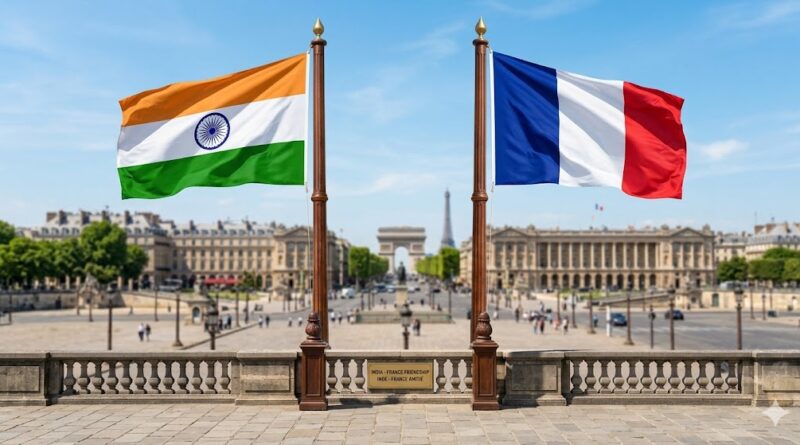
The Nice Pivot: Why the India-France Partnership Just Upgraded to ‘Economic Security’
Bilateral talks between Prime Minister Narendra Modi and French President Emmanuel Macron in Nice on Sunday have signaled a quiet but profound shift in India-France Partnership. It also gave a new perspective how New Delhi and Paris align their global interests. While no traditional joint statement emerged from the high-profile meeting, the concrete outcomes speak volumes. Earlier this year, the two nations officially renamed their partnership a ‘Special Global Strategic Partnership’ to reflect an enhanced level of cooperation. Now, they are putting real economic muscle and technological frameworks behind that label.
Redefining the Alliance: The Innovation Roadmap 2030
Recognizing the key role of innovation and technology in their bilateral relationship, both sides formally adopted the ‘Innovation Roadmap 2030’ to anchor their partnership with long-term direction.
Key highlights from this tech-first approach include:
- The AI Alliance: The leaders agreed to create a Joint India-France AI Working Group to expand cooperation in artificial intelligence.
- Ecosystem Integration: They noted the signing of 19 agreements between entities operating within the innovation ecosystems of the two countries.
- Space Exploration: The two leaders explicitly discussed expanding private sector collaboration in the space sector.
The Trade Fast-Track: Doubling Down on the India-EU FTA
The Nice talks placed heavy emphasis on accelerating bilateral economic engines. Both leaders called for the fast adoption and early implementation of the India-EU Free Trade Agreement (FTA), which was signed in February this year.
To turn these trade ambitions into reality, New Delhi and Paris agreed to set up a High-Level Mechanism aimed at doubling trade within the next five years. Beyond overall trade volume, commercial discussions focused tightly on cooperation in three critical pillars: the SME, rail, and aviation sectors.
Securing Supply Chains and the Nuclear Frontier
The establishment of the ‘Dialogue on Economic Security’ marks a highly strategic development. Under this new rubric, Mr. Modi and Mr. Macron agreed to actively strengthen supply chain resilience, focusing specifically on critical minerals.
However, the biggest commercial shift could come from the nuclear energy sector. The two leaders evaluated the implications of India’s SHANTI Act—the legislation governing the nuclear sector.
“I think the field is open for French nuclear companies in this case to start looking at direct participation in the Indian nuclear sector, or do so with in participation with Indian private sector companies, whether in conventional nuclear power reactors or in the more advanced small modular reactors.” — Foreign Secretary Vikram Misri
This perspective signals a clear opportunity for French firms to pursue direct participation or team up with Indian private sector companies in deploying conventional nuclear power reactors as well as advanced small modular reactors.
Diplomatic Caution on Global Crises
While the economic and scientific agreements were forward-leaning, the tone turned noticeably circumspect regarding global geopolitics. When addressing major international crises—specifically the ongoing conflicts in West Asia (including Iran and Gaza) and Ukraine—the official communications were remarkably guarded.
Compared to the detailed joint statement issued by the two countries on February 17, 2026, the latest press release remained highly circumspect, noting only that the leaders “exchanged views on matters of global importance, including the situation in West Asia and Ukraine”.
Education and Mobility
Beyond heavy industry, the summit delivered on human-centric diplomacy:
- Education Expansion: Prime Minister Modi invited French universities to establish physical campuses in India under the auspices of the New Education Policy.
- Smoother Transit: The Prime Minister extended personal thanks to President Macron for the speedy implementation of visa-free transit for Indian citizens at French airports.
The Nice summit demonstrates that the India-France relationship has outgrown traditional boundaries. By anchoring the relationship in AI, critical minerals, and private nuclear participation, both nations are building an economic fortress designed to withstand global volatility.