
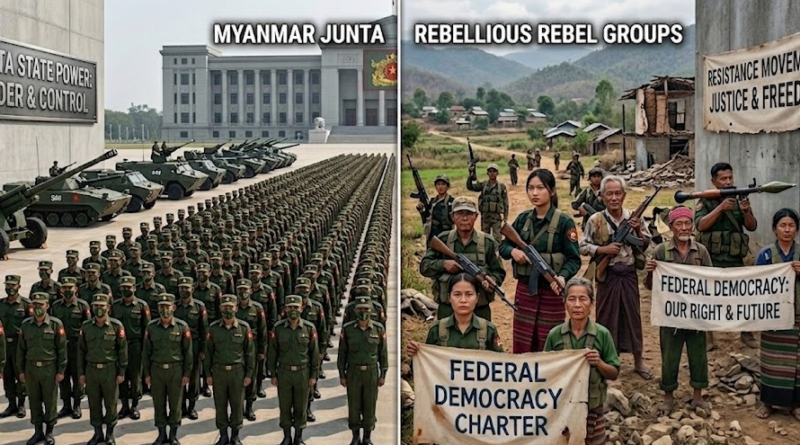
Tatmadaw Regains Ground in Myanmar’s Bloody Civil War
REPORTING FROM THE INDO-MYANMAR BORDER — For the first time since the 2021 coup, the strategic momentum in Myanmar’s brutal civil war has shifted back toward the military junta. After a year of humiliating losses and territory surrenders, the Tatmadaw (the Myanmar military) appears to have weathered the storm, bolstered by a massive conscription drive and deep-seated fractures within the resistance.
For newsdash.in and our readers across the border in Bihar and Northeast India, this shift signals a potential “crescendo” in the conflict that could redefine regional security for years to come.
The Consolation of Power: From Defense to Offensive
Just a year ago, pro-democracy guerrillas and ethnic militias had the military on its knees. Today, the landscape is unrecognizable:
- The Conscription Surge: By forcing tens of thousands of young men into service, the Tatmadaw has replenished its depleted ranks.
- President Min Aung Hlaing: The military leader who led the 2021 coup was sworn in as President earlier this month following elections widely condemned as “neither free nor fair.”
- The Peace Gambit: In his first act as President, Min Aung Hlaing invited resistance forces to peace talks—with a July 31 deadline—while pointedly excluding the shadow National Unity Government (NUG).
The Brotherhood Alliance: A House Divided
The “Three Brotherhood Alliance,” which stunned the world with the October 27 Offensive in 2023, has largely been neutralized through diplomacy and pressure:
- The Ceasefires: Under intense pressure from Beijing, both the MNDAA and the TNLA have agreed to ceasefires.
- The Last Stand: Only the Arakan Army (AA) remains in active combat in the western state of Rakhine, near the Bangladesh border.
- The China Factor: Beijing, protective of its billions in investments (pipelines and rare earth mines), has prioritized “stability” over the revolutionary cause, wielding its influence over ethnic groups along the border.
Resistance Fatigue: The ‘Weariness’ of War
Five years of fighting has exacted a horrific toll: 8,000 civilians dead and millions displaced.
- Population Burnout: Analysts suggest the general population is reaching a breaking point. “They don’t care who wins,” notes political analyst Aung Thu Nyein, “they just want the fighting to stop.”
- Infighting: The pro-democracy People’s Defense Forces (PDFs) are struggling with supply issues and a lack of “grand strategy,” with many groups still prioritizing regional or ethnic interests over a unified national front.
Geopolitical Stakes: The Russia-China Axis
While the West maintains sanctions, the Tatmadaw is far from isolated.
- Arms & Infrastructure: Both Russia and China remain the primary suppliers of hardware to the military.
- The Resource War: Myanmar is a critical source of rare earth elements for China’s tech industry. Beijing’s irritation with the junta over border crime has cooled, replaced by a pragmatism that favors a strong, albeit autocratic, central government.