
India’s GDP Jumps to 7.7% in FY26
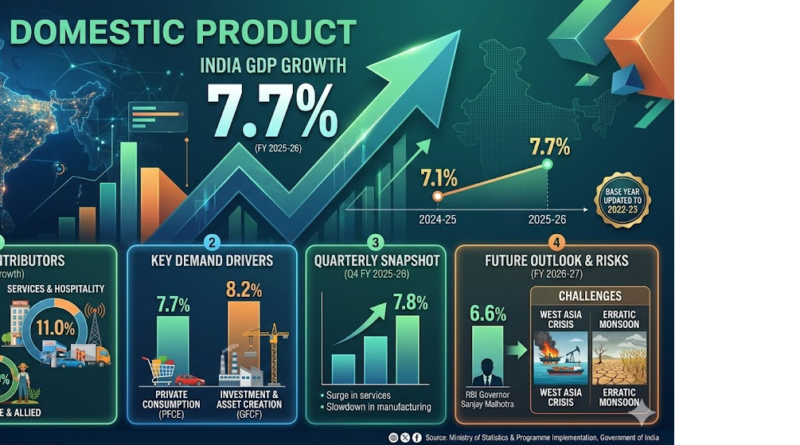
NEW DELHI — India’s economy capped off the financial year with a stunning display of muscle, clocking a 7.7% GDP growth rate for 2025-26—outperforming both the previous year’s 7.1% and the government’s own early estimates.
Driven by a roaring manufacturing engine, a massive post-pandemic rebound in hospitality and travel, and a welcome surge in everyday consumer spending, the provisional data released by the Ministry of Statistics and Programme Implementation painted a picture of an economy firing on almost all cylinders.
Yet, beneath the celebratory headlines and Prime Minister Narendra Modi’s praise for the “inherent strength” of the nation’s 140 crore citizens, a stark economic paradox is emerging. Even as India celebrates this high-octane growth, policymakers and economists are already bracing for a significant slowdown, warning that a perfect storm of global geopolitical friction and erratic weather could cool momentum in the coming months.
The Twin Engines: Factory Floors and Hotel Lobbies
The standout performers of the year were undoubtedly the manufacturing and service sectors. According to Finance Minister Nirmala Sitharaman, multiple core industries achieved double-digit growth.
- Manufacturing: Rocketed to an annual growth of 10.7%, up from 9.3% the previous year. However, a closer look at the fourth quarter (Q4) shows a drop to 7.3% (compared to 11.8% in Q4 of the previous year), hinting that factory momentum might already be losing some steam.
- Services & Hospitality: The sector encompassing trade, repair, hotels, transport, and communication saw a massive resurgence, skyrocketing to 11% annual growth from a sluggish 6.6% last year. Its fourth-quarter performance was even more dramatic, accelerating to 12.4%.
Crucially, the data indicates that regular citizens are starting to spend again. Private Final Consumption Expenditure (PFCE)—the technical measure for consumer spending—quickened to 7.7% from 5.8%. When people buy more cars, clothes, and hotel stays, businesses invest; consequently, asset creation (Gross Fixed Capital Formation) jumped by 8.2%.
The Farm Belt Friction
While urban sectors and manufacturing hubs are booming, India’s agrarian backbone is telling a vastly different story.
The agriculture sector’s growth slowed to 3% for the year, down from 4.2% in 2024-25. This widening divergence between a high-tech, high-growth industrial sector and a struggling rural economy remains a critical pain point for policymakers aiming for balanced national development.
The Coming Cool-Down: Why Economists Are Worried
The celebratory mood in New Delhi is being tempered by a sobering reality check from the central bank. Reserve Bank of India (RBI) Governor Sanjay Malhotra recently projected that GDP growth for the upcoming fiscal year (2026-27) will slow sharply to 6.6%.
When questioned about this projected 1.1% drop, Chief Economic Advisor V. Anantha Nageswaran chose not to sugarcoat the reality, calling the RBI’s conservative forecast “fair estimates” that required no second-guessing.
For now, India occupies a global sweet spot, utilizing upgraded GDP methodologies and a freshly minted 2022-23 base year to accurately chart its massive economic footprint. But as the financial year turns, the government faces the delicate challenge of sustaining this domestic momentum against a darkening global horizon.