
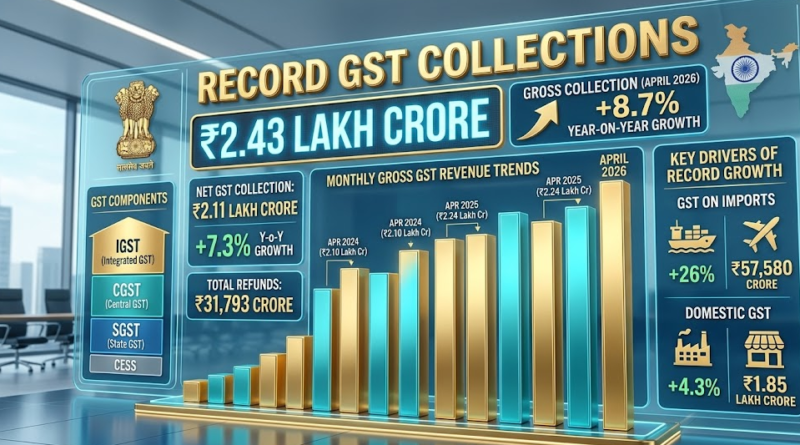
GST Collections Hit All-Time High of ₹2.43 Lakh Crore
NEW DELHI — India’s Goods and Services Tax (GST) collections reached a historic peak in April 2026, surging 8.7% year-on-year to hit ₹2.43 lakh crore. While the headline figure suggests a roaring economy, a deeper dive into the data reveals a stark divide between international trade and local spending.
The Numbers at a Glance
| Metric | April 2026 Value | Growth (YoY) |
| Gross GST Collection | ₹2.43 Lakh Crore | 8.7% |
| Net GST Collection (Post-Refunds) | ₹2.11 Lakh Crore | 7.3% |
| Import-Led Revenue | ₹57,580 Crore | 26.0% |
| Domestic Sales Revenue | ₹1.85 Lakh Crore | 4.3% |
The “March Push” and the FY26 Finale
Tax experts caution that the April record is partly due to the “Financial Year-End Effect.” Since April collections reflect business activity from March, both private companies and tax authorities make a final, aggressive push to meet annual targets before the books close on March 31. Historically, every April (except during the 2020 pandemic) has seen a record collection for this very reason.
The Import Engine vs. Domestic Cooling
The most striking feature of this report is the massive 26% jump in GST from imports.
- Supply Chain Normalization: Analysts suggest this indicates that global supply chains have stabilized, allowing Indian businesses to bring in more raw materials and capital goods.
- The Consumption Caution: Conversely, domestic sales grew by only 4.3%. Experts from Price Waterhouse & Co. suggest this “softness” might reflect a moderation in discretionary spending by Indian households, likely spooked by the ongoing West Asia geopolitical headwinds and rising fuel costs.
The “GST 2.0” Era
Despite the slower domestic growth, specialists at Deloitte India note that the regime is entering a “GST 2.0” phase. “GST 2.0” refers to the second phase of the GST regime, moving beyond initial implementation hurdles toward deep structural efficiency and trust-based compliance. This involves rate rationalization and simplification measures that are helping to keep the tax base steady even when global uncertainty is high.