
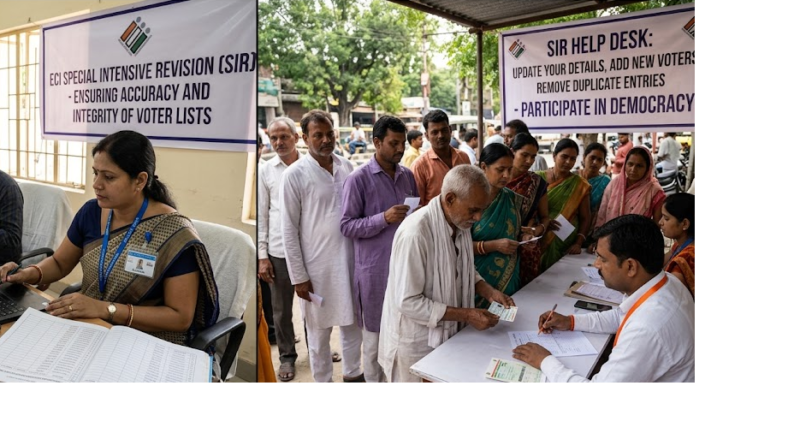
EC Launches SIR Across 4 States
BHUBANESWAR / AIZAWL / GANGTOK / IMPHAL — The ultimate countdown to clean up and fortify India’s voter base has officially begun across four critical eastern and northeastern states.
Following a directive from the Election Commission (EC), door-to-door teams and booth officials have kicked off the high-stakes enumeration phase for the Special Intensive Revision (SIR) of electoral rolls in Odisha, Mizoram, Sikkim, and Manipur.
This multi-state operation isn’t just a routine bureaucratic update; it is a massive democratic sweep. These four states represent the vanguard of the EC’s final, third-phase push that will ultimately stretch across 16 states and three Union Territories, touching a combined, staggering voter base of 36.73 crore citizens.
The June 28 Deadline: Get In or Form 6 Out
For residents in the four kickoff states, the clock is ticking. The EC has set June 28 as the hard deadline. Every eligible citizen whose completed enumeration form reaches the Electoral Registration Officer (ERO) by this date will secure a spot on the highly anticipated draft electoral rolls.
But what happens if you miss the boat or the enumerator misses your home?
Veteran poll officials emphasize that the door isn’t completely shut. Citizens who slip through the cracks of the initial phase can still fight for their democratic right during the subsequent “claims and objections” window. However, they will have to navigate the bureaucratic route by manually filing Form 6—the formal application for the inclusion of new voters—backed by a mandatory prescribed declaration form.
The Mission: Total Erasure of Ghost Voters
The EC’s mandate for this intensive drive boils down to a razor-sharp, zero-tolerance policy. In a powerful statement released Sunday, the poll body crystallized its core objective:
“Ensure that no eligible citizen is left out, while no ineligible person is included in the electoral roll.”
It is a dual-edged sword aimed at maximizing voter franchise while ruthlessly purging “ghost voters”—duplicate entries, deceased individuals, and those who have migrated. The legal baseline remains absolute: any Indian citizen who has turned 18 by the official qualifying date, and is not legally disqualified, holds an unassailable right to be registered.
The Grand Map: India’s Near-Total Democratic Refresh
With the launch of this third phase, the EC is on the verge of completing a near-total mapping of the Indian electorate. Having already executed identical intensive revisions across 10 states and three Union Territories during Phases 1 and 2—alongside a distinct special revision in Assam—this current rollout leaves almost no stone unturned.
Once the dust settles on this staggered 19-territory phase (which includes heavyweights like Maharashtra, Karnataka, Telangana, and Punjab, alongside Delhi), the intensive revision will have successfully blanketed the entire length and breadth of the country.
Only three regions remain outside this current sweep: Himachal Pradesh, Jammu and Kashmir, and Ladakh. For the rest of the nation, the message from the election watchdog is loud and clear: the registers are being wiped clean, and it is up to the citizens to ensure their names are written back in.