

India-Indonesia Revive Top-Level Joint Commission After 4-Year Hiatus
NEW DELHI— In a major diplomatic push to anchor India’s ‘Act East’ policy, External Affairs Minister S. Jaishankar and his Indonesian counterpart, Sugiono, co-chaired the 8th India-Indonesia Joint Commission meeting on Sunday.
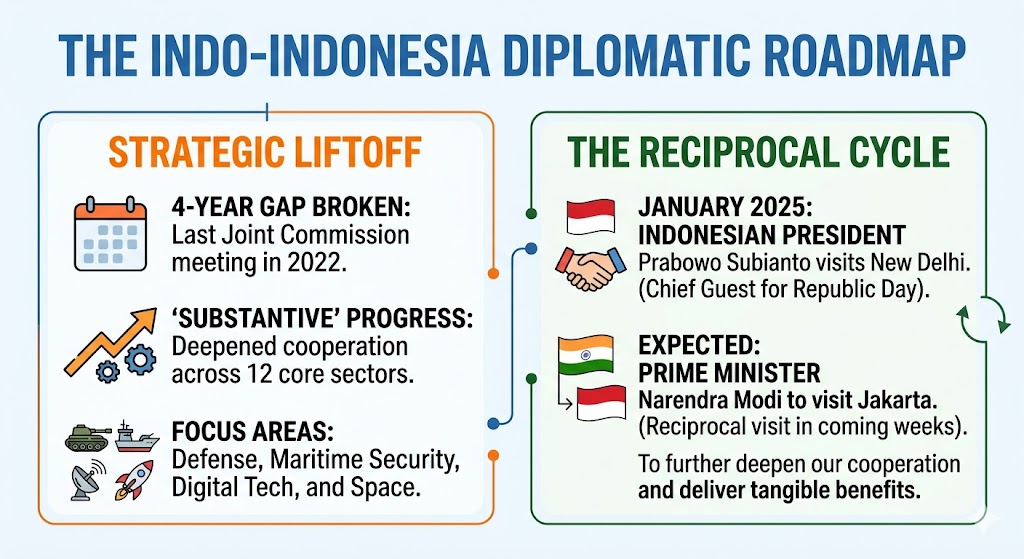
The high-stakes ministerial huddle ends a four-year hiatus for the Joint Commission, effectively serving as the curtain-raiser for Prime Minister Narendra Modi’s highly anticipated bilateral visit to Jakarta in the coming weeks.
From Deep Space to Deep Seas: A “Full Spectrum” Review
Described by Jaishankar as “substantive,” the dialogue went far beyond standard diplomatic pleasantries. According to the Ministry of External Affairs (MEA), the two leaders conducted a sweeping, full-spectrum audit of their bilateral relationship, drawing up blueprints for intense collaboration across 12 critical domains.
Key focus areas included:
- Defense & Maritime Security: Enhancing joint patrols and security coordination in the vital Indo-Pacific sea lanes.
- Trade, Investment & Energy: Streamlining economic corridors and looking into sustainable energy transitions.
- Digital, Pharma & Space: Leveraging India’s digital public infrastructure and pharmaceutical prowess while expanding joint space exploration capabilities.
Jakarta Rolls Out the Red Carpet for PM Modi
The meeting comes at a crucial geopolitical juncture. Indonesian Foreign Minister Sugiono emphasized that Jakarta is eagerly waiting to host Prime Minister Modi, stating that the upcoming prime ministerial visit will provide an “important opportunity to further deepen our cooperation and deliver tangible benefits for our peoples.”
This high-profile exchange represents the completion of a diplomatic circle. In January 2025, newly elected Indonesian President Prabowo Subianto traveled to New Delhi, taking center stage as the Chief Guest for India’s Republic Day celebrations. PM Modi’s upcoming trip to Jakarta is the official reciprocal answer to that visit, signaling that both nations view each other as irreplaceable anchors of stability in Southeast Asia.
“Despite the four-year gap in formal Joint Commission sitting, the two sides have made ‘good progress’ in bilateral ties, proving the resilience of the New Delhi-Jakarta axis,” Minister Jaishankar noted in his opening remarks.
Alignment on the Global Stage
Beyond bilateral trade and security, the two ministers spent significant time aligning their notes on shifting regional dynamics and global flashpoints.
As middle powers with significant clout in the Global South, both India and Indonesia reaffirmed their commitment to tighter coordination at regional and multilateral forums like ASEAN and the G20—sending a clear signal that the two maritime neighbors intend to write the script for regional security together.