
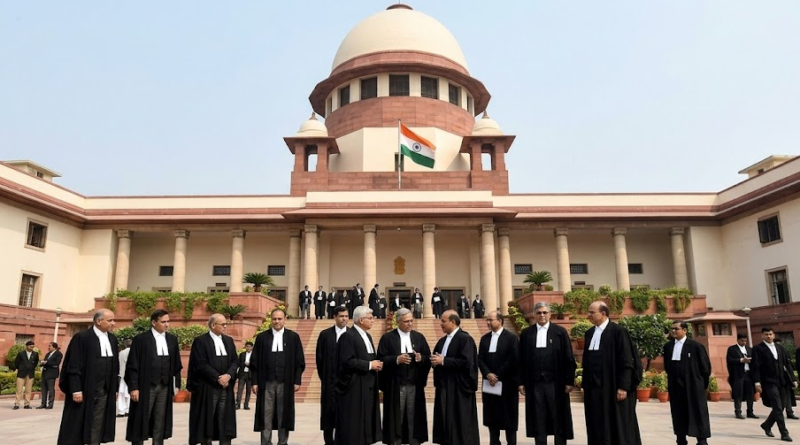
President Issues Ordinance to Increase Supreme Court Strength to 38 Amid 93,000-Case Backlog
New Delhi: In a major move to tackle the mounting pendency of cases in the judiciary, President Droupadi Murmu has promulgated an ordinance increasing the sanctioned strength of Supreme Court judges from 34 to 38 (including the Chief Justice of India).
The decision, promulgated on May 16, comes nearly two weeks after the Union Cabinet approved the proposal. It marks the first expansion of the top court’s judicial capacity after a six-year hiatus.
Key Highlights
- New Sanctioned Strength: 37 judges (excluding the Chief Justice of India), up from 33.
- Total Capacity: 38 judges (including the CJI).
- The Legal Route: Issued under Article 123 of the Constitution via The Supreme Court (Number of Judges) Amendment Ordinance, 2026.
- The Urgency: Aimed at clearing a backlog of over 93,000 pending cases.
Emergency Powers Invoked Amid Parliamentary Recess
The official Gazette notification noted the urgency behind bypass-routing the change via an executive order rather than a standard legislative bill:
“Parliament is not in session and the President is satisfied that the circumstances exist which render it necessary for her to take immediate action.”
Legislative Next Steps:
- The ordinance will be tabled in both Houses of Parliament as soon as they reconvene.
- The Deadline: It will cease to operate if six weeks expire after the reassembly of Parliament without a resolution passing it, or if both Houses pass resolutions disapproving it.
- The President retains the power to withdraw the ordinance at any time.
Tackling a “Strength Crisis” and 93,000+ Case Backlog
The ordinance directly amends Section 2 of the Supreme Court (Number of Judges) Act, 1956, substituting the word “thirty-three” with “thirty-seven.”
Judicial experts view this expansion as a vital step toward resolving a severe pendency crisis that escalated rapidly after the COVID-19 pandemic, during which the adoption of e-filing facility caused a massive surge in new case registrations.
With the Supreme Court heading into its summer recess (or “partial working days”) this June, the backlog is currently threatening to cross the six-figure mark (100,000 cases).
Vacancies and Upcoming 2026 Retirements
The increase in sanctioned strength comes at a time when the apex court is already struggling to fill existing seats. The court currently has two active judicial vacancies:
- Justice B.R. Gavai (Former CJI) – Retired November 2025
- Justice Rajesh Bindal – Retired April 2026
The manpower crunch is expected to deepen over the next few months, with three more retirements locked in for 2026:
- June 2026: Justices J.K. Maheshwari and Pankaj Mithal will end their tenures.
- August 2026: Justice Sanjay Karol is scheduled to retire.
Historical Evolution: How the Supreme Court Has Grown
The Framers of the Indian Constitution originally envisioned a compact top court. Over the last seven decades, Parliament has repeatedly stepped in to expand the bench to keep pace with the nation’s legal needs.
| Year | Sanctioned Strength (Excluding CJI) | Legal Authority |
| 1950 | 7 | Article 124(1) of the Constitution |
| 1956 | 10 | Supreme Court (Number of Judges) Act, 1956 |
| 1960 | 13 | Amendment Act, 1960 |
| 1977 | 17 | Amendment Act, 1977 |
| 1986 | 25 | Amendment Act, 1986 |
| 2009 | 30 | Amendment Act, 2009 |
| 2019 | 33 | Amendment Act, 2019 |
| 2026 | 37 | Presidential Ordinance, 2026 |