
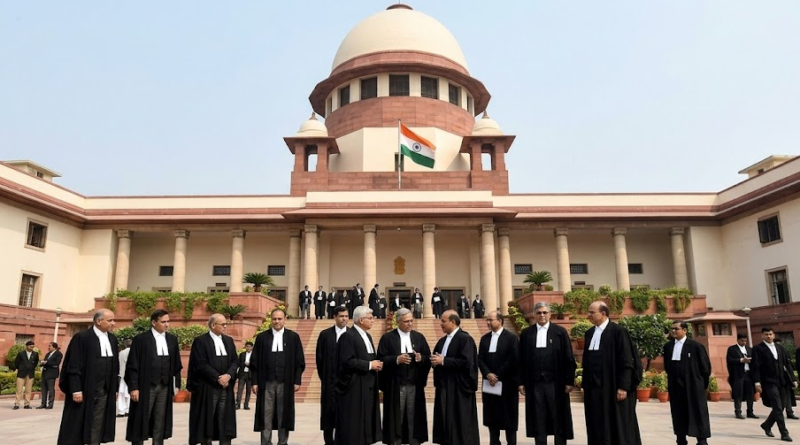
Supreme Court Refuses Reference to Larger Bench in Plea Challenging Execution by Hanging
The Supreme Court of India on Tuesday dismissed a Public Interest Litigation (PIL) that sought to challenge the constitutional validity of execution by hanging and prayed for the adoption of less painful alternatives for death row convicts.
A division bench comprising Justice Vikram Nath and Justice Sandeep Mehta held that a sufficient case was not made out to refer the landmark 1983 judgment in Deena v. Union of India to a larger Constitution bench for reconsideration.
Statutory Framework and Legal Challenge
The petition had challenged the method of capital punishment prescribed under Section 354(5) of the Code of Criminal Procedure (CrPC), 1973—corresponding to Section 393(5) of the Bharatiya Nagarik Suraksha Sanhita (BNSS), 2023—which stipulates that a death sentence shall direct that the convict “be hanged by the neck till he be dead.”
The petitioner contended that execution by hanging causes prolonged physical pain and violates the right to dignity under Article 21 of the Constitution. The plea requested the apex court to direct the exploration or adoption of modern medical methods, such as lethal injection or inert gas asphyxiation, which were argued to be less painful and more rapid.
The Precedent in Deena v. Union of India
In Deena v. Union of India (1983), a three-judge bench of the Supreme Court had scrutinized various methods of execution and concluded that hanging did not involve unnecessary pain or cruelty compared to other available options at that time, thereby declaring the statutory provision constitutionally valid.
In the present proceedings, the bench observed that the arguments advanced did not justify reopening the settled precedent of Deena. However, the Court clarified that its order does not foreclose future judicial examination if substantial and compelling scientific or medical empirical evidence is placed before the court in appropriate proceedings.
Scope for Executive Action
The bench further noted that the judicial dismissal does not prevent the Union Government from constituting an expert committee to review alternative execution methods that minimize physical trauma and preserve human dignity.
With this pronouncement, the legal challenge—wherein judgment was reserved in January 2026—stands formally concluded before the division bench.