
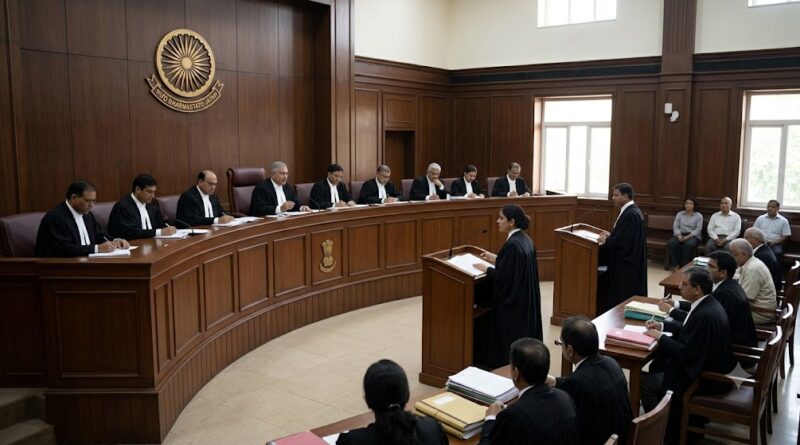
Supreme Court Weighs 24/7 ‘Emergency Room’ for Justice
NEW DELHI — The old legal adage “justice never sleeps” is on the verge of becoming a literal reality in India as . In a landmark move that could redefine the boundaries of judicial accessibility, the Supreme Court of India has agreed to consider framing a Standard Operating Procedure (SOP) to ensure citizens can knock on the doors of constitutional courts at any hour of the day or night.
The initiative targets high-stakes emergencies involving life and liberty specifically illegal detentions, midnight demolitions, imminent deportations, and custodial violence.
The Midnight Knock vs. The Morning Bell
The three-judge Bench, spearheaded by Chief Justice of India Surya Kant, was responding to a compelling petition filed by top court advocate Maheravish Rein. The petition tackles a grim, real-world reality related to state executive actions, be it an early-morning bulldozer drive or a late-night arrest, frequently occur when court gates are firmly shut.
Arguing that the protection of fundamental rights cannot be bound by the office clock, Ms. Rein delivered a striking argument to the Bench:
“The protection of liberty cannot remain dependent upon the temporal boundaries of court schedules. In a constitutional democracy governed by the rule of law, the Constitution cannot fall silent at night, nor can the protection of liberty await the morning bell of the courts.”
The petition highlights a critical systemic gap: while the state operates 24/7, the judiciary’s traditional framework restricts relief to designated hours, leaving citizens vulnerable during weekends, public holidays, and court recesses.
The Proposed Blueprint: A One-Hour Response Time
The Supreme Court didn’t just listen; it actively brainstormed. Acknowledging the need to cut through bureaucratic red tape during emergencies, Chief Justice Kant floated a radical efficiency standard.
- The Golden Hour: The Bench noted that an SOP could streamline mechanisms so that the court’s response to an urgent mention regarding life or liberty arrives within a single hour.
- The Graded Approach: Justice Joymalya Bagchi, also on the Bench, clarified that accessing justice after-hours would naturally look different than a standard day in court. This “graded approach,” he emphasized, is a matter of triage, not a denial of justice.
Digital Lifelines and Jurisdictional Hurdles
If this 24/7 judicial safety net sounds logistically impossible, the Bench points to the modern courtroom’s greatest asset: technology.
Justice Bagchi observed that in an era of e-filings, virtual hearings, and instant communication, courts never truly “close-up.” A single email, an electronic file, or even a phone call should ideally be enough to activate the machinery of justice in a crisis. While Ms. Rein agreed that the digital infrastructure is already in place, she pointed out that it has yet to be integrated into a uniform, institutional framework for after-hours emergencies.
The Administrative Tug-of-War
The path to implementation, however, faces a unique constitutional hurdle:
- The Central Government’s View: Solicitor-General Tushar Mehta suggested that the creation of such an SOP should be handled by the Supreme Court on its administrative side rather than through a judicial order.
- The Federal Reality: Chief Justice Kant quickly countered this, noting that in India’s federal setup, High Courts do not fall under the administrative jurisdiction of the Supreme Court. Therefore, to make this 24/7 access uniform across the nation, the apex court may have to pass binding orders on the judicial side.
By entertaining this petition, the Supreme Court is signaling a profound shift in how it views its role as the custodian of citizen rights. If successfully implemented, this SOP will close the structural loophole that allows executive overreach to thrive under the cover of darkness. Liberty, it seems, is finally getting its own 24/7 emergency room.