
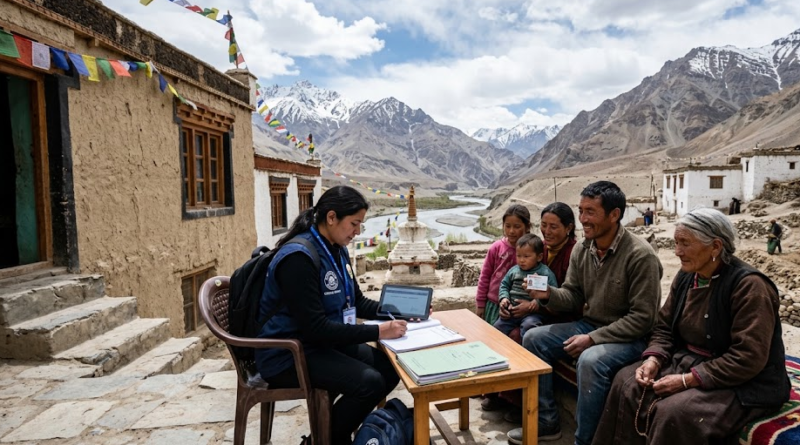
Snowbound Ladakh Set to Lead India Into Its First Caste Census in 90 Years
New Delhi/Leh — Before the rest of India even starts counting, Ladakh will already be done. The high-altitude Union Territory has been chosen to lead the Population Enumeration phase of Census 2027 — India’s first head count in sixteen years, and its first caste census since 1931 — with the self-enumeration window opening on August 17.
Under a notification issued by the Ministry of Home Affairs, residents of Ladakh and the snow-bound stretches of Jammu & Kashmir, Himachal Pradesh and Uttarakhand can log their own household details online between August 17 and 30. Enumerators will then go door to door from September 1 to 30, followed by a short revision round from October 1 to 5 to fix errors or omissions. The reference point for the exercise in these regions is fixed at midnight on October 1 months ahead of the rest of the country, which will be counted only once winter is no longer a threat to field operations in the high Himalayas.
The real headline, though, is caste. For the first time since 1931, enumerators will record the caste of every citizen, not just those belonging to Scheduled Castes and Scheduled Tribes. The method is deliberately loose: an open-ended column in which respondents simply state their caste as they identify it, with no certificate or supporting document required. Only SC and ST entries will be standardised, pulled from a state-specific drop-down list. The digital questionnaire — expected to run across roughly 40 parameters — will also, for the first time, ask for the birthplace and date of birth of a respondent’s parents, and invite voluntary disclosure of Aadhaar and passport numbers.
Not everything about the Ladakh rollout will be paperless, however. Census 2027 is being sold as India’s first fully digital count, with enumerators elsewhere carrying apps that geo-tag every household as they go. But in pockets of Ladakh that sit close to military installations, officials say enumerators will fall back on old-fashioned paper schedules instead — a concession to the security sensitivities of a region that shares a tense, unresolved border with China, where pinning exact coordinates of buildings near defence establishments is considered too risky to leave to an app.
The scale of the wider exercise is hard to overstate. Roughly 34 lakh enumerators and supervisors are being deployed nationwide, backed by an outlay of over ₹11,700 crore, for a census that arrives more than a decade late after the 2021 round was shelved during the pandemic. Ladakh’s early start is, in one sense, routine — the region has always been counted before winter cuts it off. But this time its numbers carry unusual weight: they will be the first hard data on India’s caste composition since 1931, and are likely to feed directly into fresh political battles over reservation quotas and welfare targeting once the national picture comes in next year.