
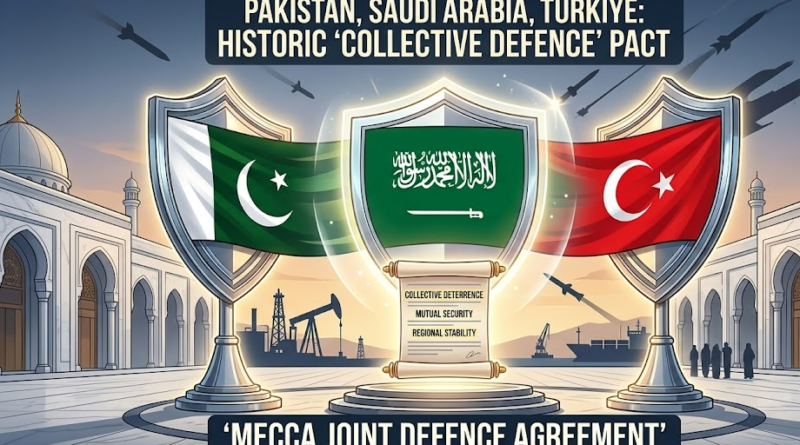
Saudi Arabia, Pakistan and Turkiye Sign Trilateral Defence Pact
Mecca: Saudi Arabia, Pakistan and Turkiye put their signatures to a new collective-defence agreement in Mecca on Friday, pledging “collective deterrence” and agreeing that an armed attack on any one of the three would be treated as an attack on all three. The signing comes as Saudi Arabia faces continuing strikes from Yemen’s Houthi movement, while the wider West Asian region remains gripped by the ongoing conflict pitting the United States and Israel against Iran.
The three signatories — a wealthy Gulf monarchy, a nuclear-armed South Asian state, and a NATO member — framed the pact as a step toward stronger regional “collective deterrence.” It was formalised at what organisers called the Mecca Al-Mukarramah Summit for Joint Defence, with Saudi Crown Prince and Prime Minister Mohammed bin Salman, Turkish President Recep Tayyip Erdogan, and Pakistani Prime Minister Shehbaz Sharif all in attendance.
Pakistan’s Foreign Ministry said in a joint statement that the three leaders had gathered at Al-Safa Palace on King Salman bin Abdulaziz’s invitation, where they discussed bilateral relations and broader regional matters before finalising what is now called the Mecca Joint Defence Agreement. The statement described the accord as an expression of shared commitment to collective security, meant to advance long-term peace and stability both within the region and beyond it.
A Turkish government official offered a somewhat different framing — describing the pact as a purely defensive arrangement not aimed at any particular country, intended instead to reinforce shared efforts toward regional and global peace through burden-sharing and joint security arrangements.
A region already under strain
The timing is notable. West Asia has spent months in an escalating security crisis: the war the US and Israel opened against Iran on 28 February has yet to be resolved, and Arab Gulf states have absorbed repeated Iranian strikes over the past five months. Just last month, Houthi forces — aligned with Iran and formally known as Ansar Allah — struck Saudi oil infrastructure and blockaded the kingdom’s Red Sea ports, in what followed an earlier attack on a Yemeni airport.
An earlier pact, an untested record
This isn’t the first such commitment in the region. In September 2025, shortly after Israel struck Qatar, Saudi Arabia and Pakistan signed their own Strategic Mutual Defence Agreement, similarly pledging that aggression against either party would be treated as aggression against both. In the months since, Pakistan has repeatedly clashed with the Taliban government in Afghanistan, while Saudi Arabia has weathered continued attacks from Iran and the Houthis — yet neither country has stepped in militarily to defend the other. That gap between commitment and action has left open questions about how far such mutual-defence pledges actually extend in practice.
The new trilateral pact goes further on paper, according to the joint statement, which speaks of broadening cooperation across every dimension of defence among the three states — language pointing toward tighter military coordination and wider security collaboration than the earlier bilateral agreement offered.
Strategic stakes for each side
Bringing Turkiye and Pakistan into the arrangement also signals a deepening alignment among three of the Muslim world’s most influential states. Turkiye has been angling for a larger security footprint across West Asia, while Pakistan — itself a nuclear power — has spent recent years working to expand its regional role, both as a security partner and as an intermediary between Iran and the United States.
Not everyone welcomed the pact. In Iran, Ebrahim Rezaei, a member of parliament’s National Security and Foreign Policy Commission, dismissed the agreement on social media platform X, arguing it would do nothing to make Saudi Arabia more secure.