
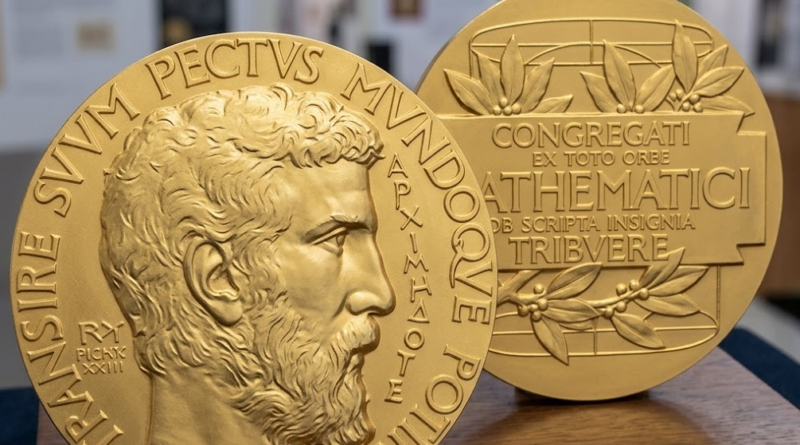
Fields Medal 2026 Awarded to Four People
The 2026 Fields Medal, widely regarded as the highest honor in mathematics, has been awarded to Yu Deng, John Pardon, Jacob Tsimerman, and Hong Wang. Awarded every four years to mathematicians under the age of 40, the medal recognizes extraordinary contributions to mathematical research.
Historic Milestones of the 2026 Awards
- Breakthrough for Women in Mathematics: Hong Wang has become only the third woman to receive the Fields Medal in its 90-year history, following Maryam Mirzakhani (2014) and Maryna Viazovska (2022).
- Chinese Representation: Wang and Deng are the first Chinese nationals to win the Fields Medal since Shing-Tung Yau in 1982.
Profiles of the 2026 Laureates & Their Contributions
1. Yu Deng (University of Chicago)
- Area of Focus: Mathematical Physics & Partial Differential Equations.
- Key Achievement: Solved a fundamental component of David Hilbert’s legendary list of 20th-century mathematical problems.
- Impact: In collaboration with Zaher Hani and Xiao Ma, Deng built groundbreaking bridges between observable physical phenomena (such as fluid motion) and the underlying mathematical laws governing particle interactions.
2. John Pardon (Stanford Ph.D. / Symplectic Geometry)
- Area of Focus: Symplectic Geometry (the mathematics describing motion in physical systems, such as planetary orbits or rolling objects).
- Key Achievement: Resolved the 20-year-old MNOP conjecture, which involves counting curves on complex geometric constructs known as Calabi-Yau 3-folds.
- Early Recognition: Previously solved a 30-year-old problem on knot distortion while an undergraduate at Princeton, earning the 2012 Morgan Prize.
3. Hong Wang (Courant Institute)
- Area of Focus: Geometric Analysis & Harmonic Analysis.
- Key Achievement: Solved the three-dimensional Kakeya conjecture alongside Joshua Zahl, publishing a definitive 127-page solution in 2025.
- Background: The Kakeya problem asks for the minimum space required to fully rotate a needle in every direction. While solved for a 2D plane, the 3D version eluded mathematicians for over half a century until Wang and Zahl’s breakthrough.
4. Jacob Tsimerman (University of Toronto)
- Area of Focus: Number Theory & Algebraic Geometry.
- Key Achievement: Successfully proved Griffith’s conjecture by introducing o-minimality—a tool from mathematical logic—into algebraic geometry and number theory.
- Career Highlight: Previously co-proved the André-Oort conjecture (earning the 2015 SASTRA Ramanujan Prize). On the day of his Fields Medal announcement, Tsimerman revealed he is joining the Safety Research Group at OpenAI.