
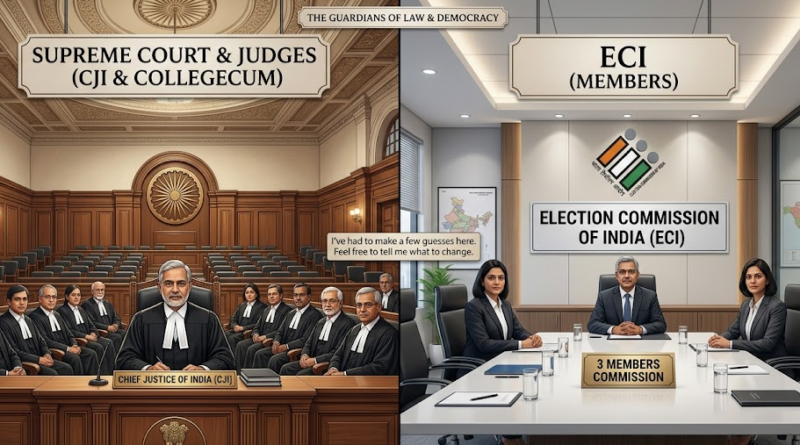
Supreme Court: CJI’s Role in EC Appointments Was “Stop-Gap” Until Law Was Made
NEW DELHI – The Supreme Court on Wednesday clarified that the inclusion of the Chief Justice of India (CJI) in the selection process for top election officials was never intended to be permanent. A bench comprising Justices Dipankar Datta and Satish Chandra Sharma observed that the judicial involvement was a temporary arrangement meant to last only until Parliament exercised its constitutional power to enact a formal law.
The observations came during a high-stakes hearing on a batch of petitions challenging the Chief Election Commissioner and other Election Commissioners (Appointment, Conditions of Service, and Term of Office) Act, 2023.
The Constitutional Tug-of-War
The legal battle centers on the composition of the committee that selects the Chief Election Commissioner (CEC) and Election Commissioners (ECs).
- The 2023 Judgment: In March 2023 (Anoop Baranwal v. Union of India), a Constitution Bench ruled that the selection panel must include the Prime Minister, the Leader of the Opposition, and the CJI.
- The 2023 Act: In December 2023, Parliament passed a new law that replaced the CJI with a Union Cabinet Minister nominated by the Prime Minister.
The petitioners, including the Association for Democratic Reforms (ADR) and activist Jaya Thakur, argue that this swap grants the political executive “exclusive control” over the poll body, effectively allowing the government to handpick its own referees.
“Not the Prime Minister’s Man”
Representing the petitioners, senior advocate Vijay Hansaria delivered a sharp critique of the new law, asserting that the independence of the Election Commission is a “basic feature” of the Constitution.
“The Constitution framers never intended the CEC to be the ‘Prime Minister’s baby’ or the ‘Prime Minister’s man’,” Hansaria argued, adding that the selection process must be insulated from the party in power to ensure “fierce independence.”
Senior advocate Gopal Sankaranarayanan further contended that while the 2023 judgment addressed a “legislative vacuum,” the new Act simply reverted the power back to the executive—an arrangement he claimed political parties have found “convenient” since the 1950s.
The Court’s Question on Mandamus
Justice Datta, however, pushed back on the idea that the judiciary could dictate the exact contents of a law to Parliament. He highlighted that the court’s own judgment in 2023 was explicitly operative only “till Parliament makes a law.”
The Bench raised two critical questions:
- Does Parliament have the power to make this law? (Yes).
- Can the Court issue a mandamus (a judicial command) to Parliament to include the CJI in a specific way?
“Are you saying Parliament did not have the power to make the law?” Justice Datta asked. “The court said certain norms should be followed till a law is laid down. Once a law is framed, can you say these norms are not being followed?”
Current Leadership and Next Steps
The current CEC, Gyanesh Kumar, was the first official appointed under this contested 2023 mechanism. As the hearing concluded for the day, the court refused to adjourn the matter despite the Solicitor General’s request, noting that the independence of the poll body is “more important than any other case.”