
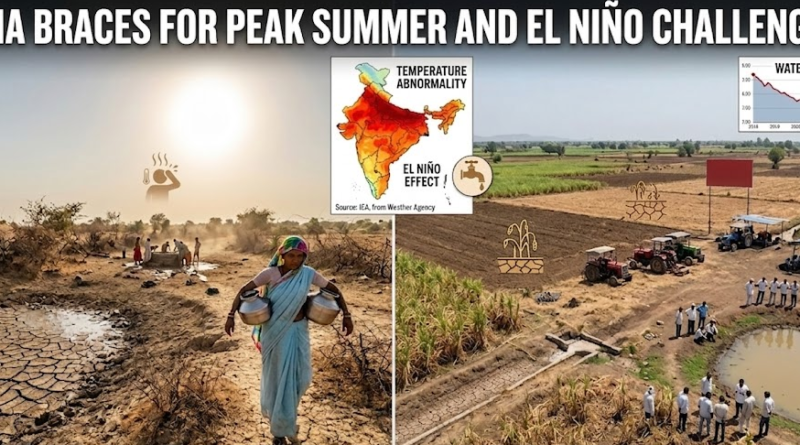
India Gears Up for El Niño Summer with Record Solar Surge
NEW DELHI — As India stares down the barrel of a blistering summer and a looming El Niño effect, the nation’s power grid is undergoing a historic “Dual Paradigm” shift.
New data reveals that while traditional coal remains the undisputed heavyweight of Indian energy, a record-breaking surge in solar capacity is finally beginning to move the needle.
1. The “Big Two”: Thermal and Solar
On April 25, 2026, India hit a staggering peak demand of 256.1 GW. The way that demand was met provides a roadmap of our current energy landscape:
- Coal is King: Thermal plants accounted for 66.9% of generation, proving that coal remains the backbone of the grid during high-stress periods.
- The Solar Leap: Solar energy contributed 21.5% of the power generated during peak demand. To put that in perspective, solar’s contribution during the 2022 peak was a mere 5.63%.
2. The El Niño Factor: Heatwaves on the Horizon
The India Meteorological Department (IMD) has issued a “Heatwave Alert” for several states, including Gujarat, Maharashtra, West Bengal, and Andhra Pradesh.
- The Dry Spell: El Niño conditions are expected to persist through the monsoon months (June–September), likely leading to weak rains and longer dry spells, which will drive up the demand for air conditioning and irrigation.
- The Coal Cushion: Government officials have assured The Hindu that India is sitting on 200 million tonnes of coal stocks. At the current consumption rate of 2.4 million tonnes a day, India has an 83-day buffer—enough to survive the summer even if supply chains are strained.
3. The “Battery” Bottleneck
Despite adding a record 44.61 GW of solar capacity in FY26 alone (double the previous year), India faces a structural hurdle.
- The Storage Gap: Because battery storage is still limited, solar power is often “curtailed” (cut off) to keep the grid stable.
- The Night-Time Challenge: Experts like Manoj Kumar (CREA) point out that while we have plenty of solar during the day, we need faster battery deployment and stronger transmission to meet evening and night-time demand using non-fossil sources.