
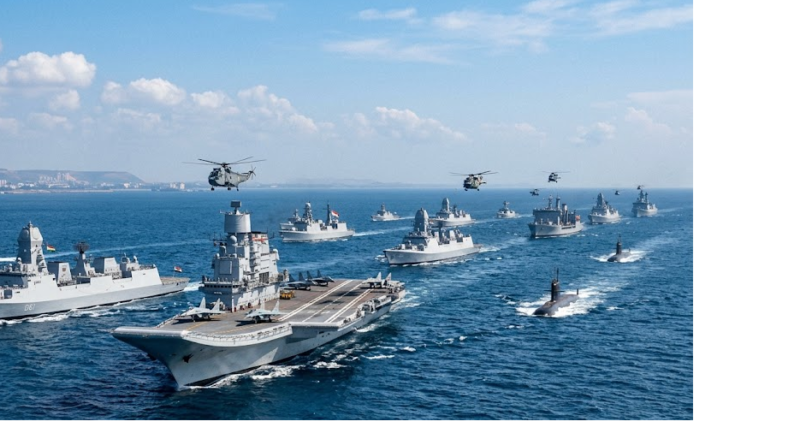
The Blue-Water Blueprint: Why India’s New Naval Trio Signals a Shift in Global Power
Bilateral dominance and regional security aren’t just won on land; they are anchored at sea. In a historic “tri-commissioning” ceremony on Sunday, Prime Minister Narendra Modi sent a clear message to the world: India’s path to becoming a major global power runs directly through its oceans.
By simultaneously commissioning three indigenously built naval vessels, New Delhi hasn’t just upgraded its hardware—it has formalized a mature, self-reliant maritime calculus.
The New Vanguard: Three Vessels, Three Critical Roles
The simultaneous induction of three distinct classes of ships underscores the sophistication of India’s domestic defense manufacturing ecosystem. These are specialized tools designed to project power, map assets, and secure vital sea lanes.
- INS Dunagiri: An advanced stealth frigate designed to slip under enemy radar, packing a lethal offensive punch while maintaining a minimal radar signature.
- INS Sanshodhak: A survey vessel (large) that will map the ocean floor, which is absolutely critical for both underwater submarine navigation and strategic resource tracking.
- INS Agray: An anti-submarine warfare shallow watercraft engineered to neutralize stealth threats lurking in coastal waters and littoral zones.
The Macroeconomics of Maritime Might
The government no longer views the maritime sector through an isolated, purely tactical lens. Instead, shipyard infrastructure is being treated as a major engine for employment and economic growth. The strategy hinges on an undeniable historical truth: a country with robust maritime strength will naturally project equally robust economic and strategic influence.
“The strength of the nation’s military cannot be measured by its dependence on global markets but by its ability to become self-reliant. India seeks to become a producer and a manufacturer, because nations that manufacture become decisive players on the global stage.” — Prime Minister Narendra Modi
This shift from a passive defense importer to an active producer is well underway. The Indian Navy has quietly inducted more than 40 indigenously built warships and submarines over the past few years, showing that Aatmanirbhar Bharat (Self-Reliant India) has transitioned from a political slogan to a concrete structural reality.
The End of Defense Dependence
Defense Minister Rajnath Singh called this tri-commissioning a “defining moment,” and it is difficult to argue with that assessment. For decades, India was pigeonholed as one of the world’s largest defense buyers, frequently left exposed to foreign supply chain vulnerabilities, geopolitical pivot shifts, and delayed technology transfers.
By manufacturing complex stealth frigates and specialized anti-submarine warfare craft entirely at home, India is rewriting the rules of its engagement with global powers. True strategic autonomy isn’t maintained by writing checks to foreign defense conglomerates; it is built on your own coastlines. As the Indian Ocean grows increasingly crowded and contested, a self-reliant navy ensures that New Delhi remains a decisive driver of global maritime security rather than a bystander.