
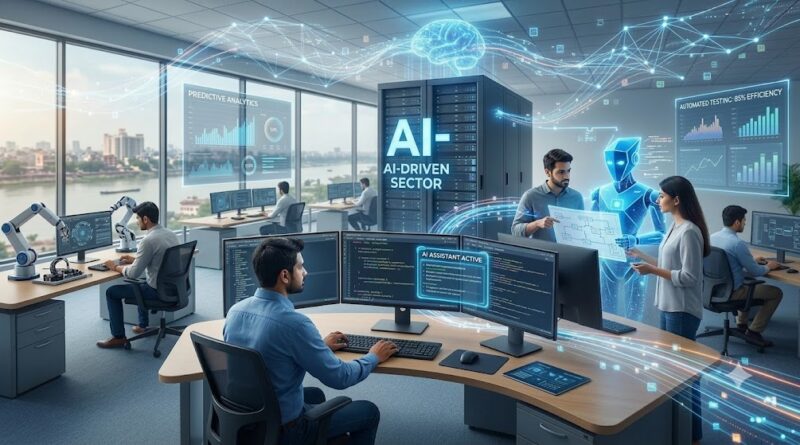
The Claude Catalyst: Why Anthropic’s ‘Fable 5’ Just Sent a Shiver Down Indian IT’s Spine
It took just one public product launch from an American AI heavyweight to wipe 1.6% off the Nifty IT index on Wednesday. When Anthropic opened the doors to Fable 5—a restricted yet fiercely potent variant of its next-generation Claude Mythos 5 engine—Dalal Street didn’t just notice; it flinched.
For decades, the core engine of the Indian IT services sector was built on linear headcount growth and software maintenance. Today, that multi-billion-dollar narrative is staring down a structural existential crisis.
The Market Bleeds: Counting the Cost of Automation
The market reaction was swift, brutal, and deeply telling. Industry experts wasted no time pointing out that Fable 5’s advanced software engineering capabilities place legacy IT revenue streams at immediate risk.
According to Sumit Pokharna, Senior VP of Fundamental Research at Kotak Securities, the market is looking at a projected 3% to 5% deflation in revenues for Indian IT majors.
How the Nifty IT 10 Reacted:
| IT Major | Wednesday’s Drop | Closing Price (₹) |
| Infosys | 🔻 2.50% | ₹1,114.60 |
| Oracle Financial (OFSS) | 🔻 1.90% | Cheaper by 1.9% |
| HCL Tech | 🔻 1.60% | Shaved 1.6% off |
| Persistent Systems | 🔻 0.87% | ₹4,874.00 |
Inside Fable 5: Why This Time is Different
Why the panic over just another AI model update? Because Anthropic isn’t building simple text-summarizers anymore. Fable 5 represents the absolute state-of-the-art across nearly all tested benchmarks of AI capability, showing unprecedented mastery in autonomous software engineering, complex knowledge work, and scientific research.
In a statement that should make every traditional project manager sweat, Anthropic noted:
“The longer and more complex the task, the larger Fable 5’s lead over our other models.”
To make matters more disruptive, Anthropic is pivoting its financial model from a standard subscription base to a usage-based pricing structure. This drastically lowers the financial barrier for global enterprises looking to swap out expensive entry-level engineering contracts for pure, on-demand compute.
The Counter-Offensive: TCS Chooses Alliance Over Anxiety
While the rest of the index bled, Tata Consultancy Services (TCS) decided that the best way to survive a disruption is to buy early access to it. In a massive strategic pivot, India’s largest IT exporter announced a global strategic partnership with Anthropic.
TCS isn’t just dipping its toes in the water; it is diving headfirst:
- Dedicated Claude Business Unit: TCS is establishing a specialized wing focused entirely on delivering joint industry solutions and deep AI expertise built on the Claude family of models.
- 50,000 Licenses: TCS will immediately equip 50,000 of its own associates across engineering, finance, legal, marketing, and sales with Claude enterprise-wide licensing.
By consuming its own medicine, TCS is attempting to transition from a company that competes with AI to a company that deploys it.
The Arbitrage Era is Officially Dead
For years, tech evangelists warned that generative AI would eventually mature from a novelty into a tool capable of replacing the “code-maintenance” layer of IT services. Fable 5 is proof that that day has arrived in 2026. A 3% to 5% revenue deflation might sound manageable on paper, but in a high-volume, low-margin business, it is a tectonic shift.
The stark contrast between Infosys dropping 2.5% and TCS aggressively licensing 50,000 seats of the very software threatening its industry tells you everything you need to know. The future of Indian IT no longer belongs to companies with the largest engineering armies; it belongs to those who can orchestrate the smartest AI legions. TCS just handed the sector its new blueprint. The only question left is: how fast can the rest of the Nifty 10 pivot?