
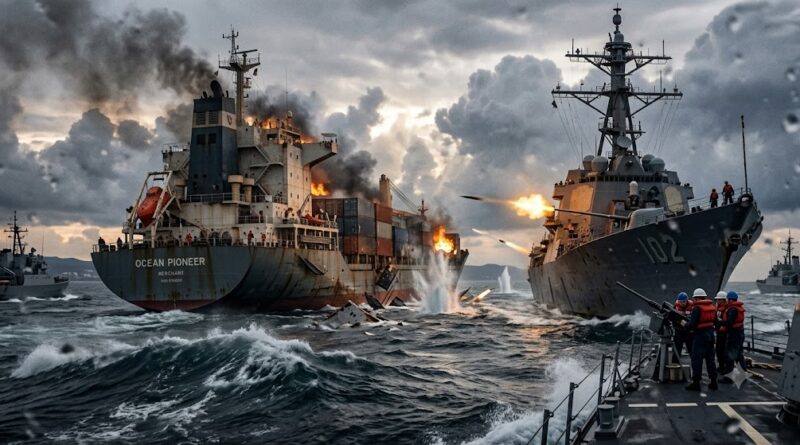
Why U.S. Strikes on Indian Seafarers is New Delhi’s Next Diplomatic Nightmare
For a country that prides itself on its massive global maritime footprint, the headlines coming out of the Gulf of Oman this week are nothing short of chilling. In a staggering escalation of regional tensions, U.S. forces have attacked a merchant ship carrying Indian seafarers for the third time in just four days.
This isn’t a case of collateral damage or mistaken identity. It is a calculated, aggressive enforcement of blockades that has caught innocent Indian sailors directly in the line of fire.
The Latest Flashpoint: The Jalveer
On Thursday, the Guinea-Bissau flagged bitumen carrier Jalveer was struck off the port of Shinas, Oman. The vessel’s safety manager is an Indian company based out of Chembur, Mumbai, and it was manned by 20 Indian seafarers.
According to Mukesh Mangal, Additional Secretary of the Ports, Shipping and Waterways Ministry, the crew is thankfully safe and evacuation efforts to Shinas port have commenced.
But the justification from U.S. Central Command (Centcom) paints a much darker picture. Centcom admitted to firing two Hellfire missiles directly into the Jalveer’s engine room, claiming the ship was “attempting to transport Iranian oil” and had repeatedly failed to comply with U.S. Navy directions.
Disabling, Not Sinking: A Terrifying Tactical Pattern
A closer look at the three recent attacks—which include strikes on the Palau-flagged tankers Marivex on Monday and Settebello on Wednesday—reveals a specific, terrifying tactical blueprint:
- The Target: U.S. aircraft are deliberately targeting the engine rooms and steering compartments, always above the waterline.
- The Objective: The strategy is designed to immediately cripple the ship’s ability to move or maneuver, effectively turning them into sitting ducks without actually sinking the vessel.
- The Risk: While it avoids an immediate environmental disaster or total vessel loss, firing high-grade military missiles into a ship’s engine room while human beings are working inside is a recipe for catastrophe.
And catastrophe has already struck. On Thursday, the Indian government confirmed that three Indian seafarers died during Wednesday’s attack on the Settebello. Among them was 23-year-old deck cadet Aditya Sharma from Himachal Pradesh, who had extended his contract by just a month, only to be caught in a geopolitical crossfire.
The Diplomatic Tightrope & Political Backlash
The Ministry of External Affairs (MEA) has gone into overdrive. The government has summoned U.S. Chargé d’affaires Jason Meeks to lodge a “strong protest,” describing the strikes as “deeply worrisome.” Yet, in a nod to the delicate diplomatic balancing act New Delhi must play, the MEA stopped short of directly vilifying Washington, instead blaming the broader, volatile conflict between the U.S.-Israel axis and Iran.
However, the government won’t find it as easy to defuse the domestic political explosion. The Congress party wasted no time in launching a scathing critique of Prime Minister Narendra Modi’s foreign policy.
“PM Modi has repeatedly showcased his personal rapport with President Donald Trump as a diplomatic achievement. He should not evade responsibility when that relationship fails to protect Indian lives and interests.” — Official Congress Statement
The Invisible Frontline
The Directorate General of Shipping did issue an advisory in mid-February warning recruiters not to deploy seafarers on ships calling on Iranian ports. But as official sources point out, the crews on these three targeted vessels had joined well before that warning went live. They didn’t sign up to be blockade-runners; they signed up to do a job.
This situation exposes a structural vulnerability for India. Our seafarers are the literal lifeblood of global trade, often staffing foreign-flagged vessels managed by third-party companies. When global superpowers decide to engage in economic warfare on the high seas, these sailors become invisible pawns.
Summoning diplomats and expressing “deep worry” is standard statecraft. But when Hellfire missiles are being shot into rooms where young Indian men are working, standard statecraft isn’t enough. New Delhi needs to draw a hard red line with Washington: sanction-enforcement cannot come at the cost of Indian blood.