
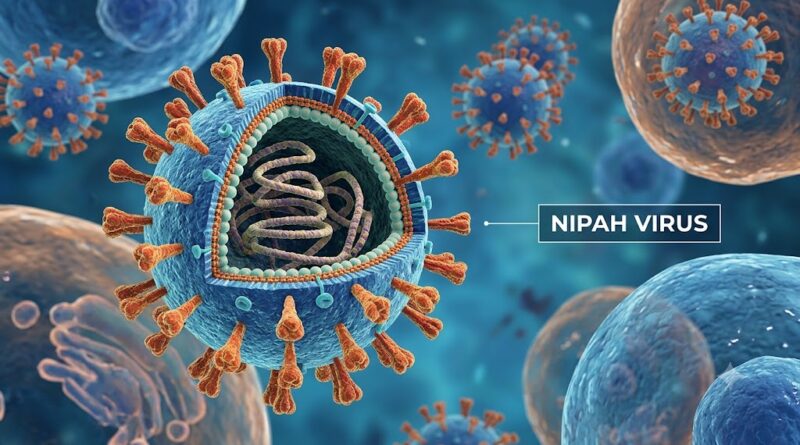
Nipah virus Returns to Kozhikode: Inside Kerala’s High-Stakes Battle to Prevent a Spillover
Kerala is no stranger to the shadow of the Nipah virus. Yet, every time this deadly pathogen re-emerges, the state’s healthcare machinery transitions into a battle posture that is nothing short of military-grade.
This week, the alarm bells rang once again in Kozhikode. With a 43-year-old man battling severe encephalitis symptoms on a ventilator at the Government Medical College Hospital (MCH), the state Health Department has unleashed a textbook containment strategy to ensure this single spark doesn’t trigger a full-blown human-to-human wildfire.
The Patient at the Epicenter
The patient, a resident of Ramanattukara, was shifted to the Kozhikode MCH from a private hospital on Wednesday. While his condition is critical enough to require mechanical ventilation, health officials confirm that he is currently stable.
However, the real challenge for epidemiologists isn’t just treating the patient—it’s tracing his steps. The patient has been symptomatic and visiting multiple healthcare establishments since May 10. This multi-week window creates a significant risk for nosocomial (hospital-acquired) transmission, making the tracking process an absolute race against time.
The Contact Tracing Matrix: 77 and Counting
Following a high-level review meeting in Thiruvananthapuram, Health Minister K. Muraleedharan revealed that a meticulous contact list of 77 individuals has already been mapped out.
Given the nature of the virus, healthcare workers—the frontline soldiers—are currently bearing the brunt of the exposure risk.
The Breakdown of the Contact List
- Healthcare Workers: 58 (Doctors, nurses, and hospital staff who attended to him across different facilities)
- Family Members: 14
- Co-workers & Friends: 5
Risk Categorization
The medical team has strictly stratified these 77 contacts based on their level of exposure to ensure targeted monitoring:
| Risk Level | Number of Persons | Action Protocol |
| Highest Risk | 2 | Isolation & immediate fluid testing |
| High Risk | 13 | Strict home quarantine & daily symptom tracking |
| Low Risk | 62 | Passive monitoring for incubation period |
The Silver Lining
As of right now, Health Minister Muraleedharan confirmed there is no immediate need for a containment zone, as none of the 77 contacts have exhibited any symptoms. The threat remains localized to the isolation wards for now.
The War Room Activates
The state is relying heavily on its past battle experience with Nipah to prevent panic while enforcing maximum vigilance. The Rapid Response Team (RRT) in Kozhikode has already finalized its emergency protocols:
- Route Map Construction: Health officials are actively publishing the patient’s movement timeline since May 10 so the public can self-report if they crossed paths at any medical facility.
- Logistics & Supplies: Adequate stocks of Personal Protective Equipment (PPE) kits, antiviral medications, and supportive care drugs have been moved to Kozhikode.
- Control Room Operationalized: A centralized control room has been opened at the Kozhikode District Medical Administration’s office to handle public anxiety, track the contact list, and dispel misinformation.
Why Complacency is the Real Enemy
Kerala’s public health infrastructure is arguably the most battle-tested in India when it comes to dealing with rare zoonotic outbreaks. The speed with which 58 healthcare workers were identified and categorized within hours of the diagnosis is a testament to that.
However, the “May 10” timeline should make everyone uneasy. The virus had a head start of nearly a month before hitting the radar at the Government Medical College. The real test over the next 48 hours will be ensuring that the “Highest Risk” contacts do not turn into active transmitters. In the world of epidemiology, paranoia is a virtue. Kerala’s healthcare system is acting appropriately paranoid and that is exactly what will save lives.